Dissolution Tester BioDis RRT 10 (USP 3 / USP 7)
Brand: Erweka | Category: Scientific & Laboratory Equipment
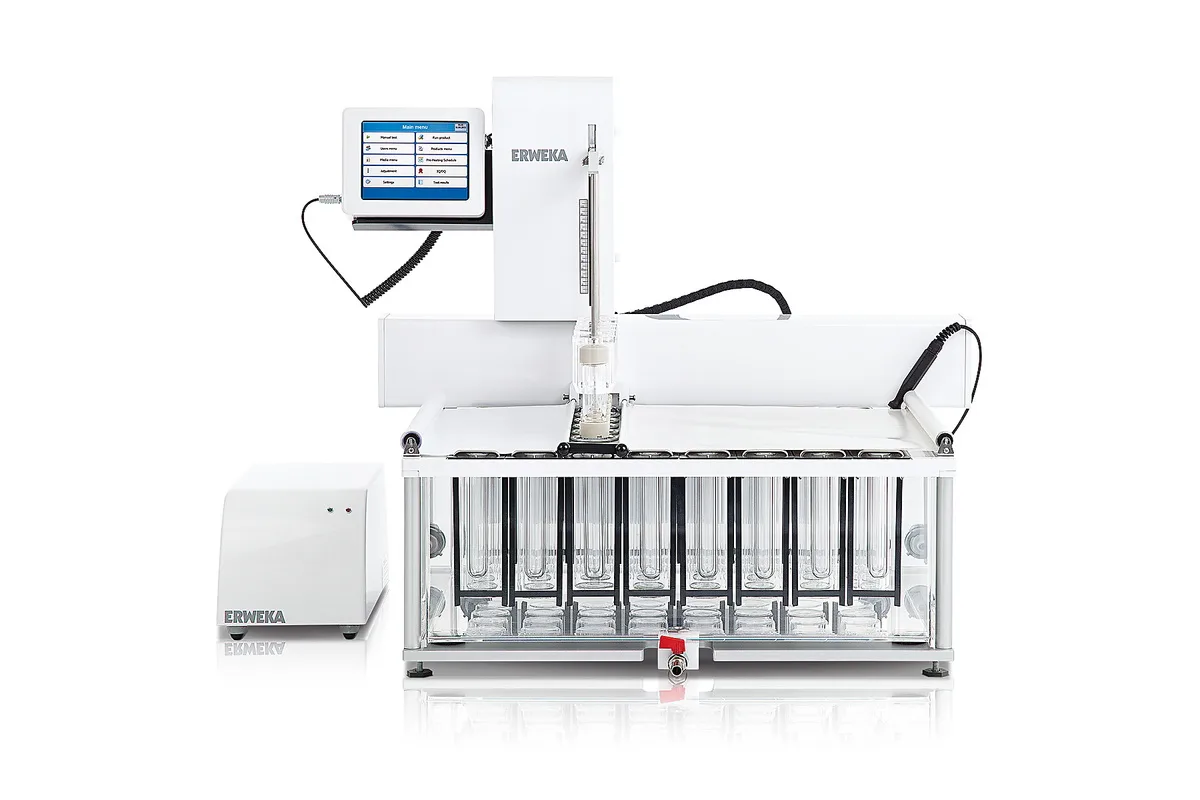
The RRT 10 automates dissolution testing for extended and sustained release dosage forms and is suited to simulating the pH changes within the human body. Placing a different medium in each row lets the instrument mirror varying gastrointestinal conditions in vivo, and automatic sample transport between rows supports reliable release testing across different pH zones. Erweka supply it as a USP method 3 device, a USP method 7 device, or a combination of both, with an external flow through heater that minimises vibration and a detachable touch display. Vessels sit in an acrylic water bath with an outlet valve for cleaning, and an automatic cover system reduces evaporation of the media.
Technical Specifications
| Parameter | Value |
|---|---|
| Weight | 50 kg |
| Dimensions (H x W x D) | 690 x 630 x 670 mm |
| Voltage | 110/220/240 V; 50-60 Hz |
| Fuses | 115V/250V, 15A T (slow) 2x 250V, 1A T (slow) / 115V, 2A T (slow) |
| Test stations | 8 rows with 6 stations (standard configuration) and 2 vials for reference purposes or 7 test stations without reference positions |
| Water bath | Water bath of 30 litres volume, clear acrylic glass |
| Thermostat | Heating rate 1500 w, 30-50° C, accuracy +/- 0.2° C |
| Temperature control | External PT 100 temperature sensor |
| Test vessels (standard) | 300 ml USP-compliant cylindrical flat bottomed glass vessels (standard configuration) |
| Test cylinders (USP method 3) | USP-compliant glass reciprocating cylinders fitted with mesh screens of stainless steel or synthetic material (automated centring inside the vessel) |
| Formulation holder (USP method 7) | Whole range of USP-compliant holders for non-eroding formulations made of stainless steel or polytetrafluoroethylene |
| Speed | Speed adjustable from 5-40 strokes/min., accuracy better than +/- 5 % |
| Evaporation | Vessels protected by automated covering system |
Published manufacturer data for the listed model or variants. Confirm the exact configuration, accessories and test conditions in the quotation. Checked 2026-09-29.
Confirm your configuration
Share the details you know so we can prepare a comparable, itemised offer.
- Test method, dosage form and required throughput
- Exact model configuration, measuring range and method-specific accessories
- Data handling, qualification/calibration documents and operator training
Get a Quote
Request an itemised quotation covering the proposed configuration, availability, lead time and agreed supply and support scope.
Useful details to share
- Intended application, process or teaching activity
- Required capability and equipment it must work with
Share what you know. You can start with your name and a phone number or email; final specifications can follow.
Not sure which configuration you need? Help me choose
Contact Vvon Technologies Limited about Erweka equipment requirements in Bangladesh.
Phone: +8801805987890 | Email: info@vvon.com.bd
Back to Scientific & Laboratory Equipment
More from Laboratory Instruments
- Flow-Through Cell DFZ II (USP 4)
Erweka's DFZ II flow through cell tester covers a wide range of applications thanks to the variety of cell types available, including testing of poorly soluble products and low dose sustained release formulations. A cell design with increased leak tightness and an optimised tubing system with quick locks let tests be prepared and run quickly. The standardised cell head fits every cell body on offer and, with flat gaskets reduced to three parts per cell, handling and installation are simplified. Cell bodies have reduced wall thickness for improved warming and each cell can be heated individually via a rotary switch. All USP 4 DFZ II systems are controlled through a controller running Disso.NET 3.X software.
- Dissolution Tester DT Light Series (DT 126 Light, DT 128 Light)
The DT Light series packages proven Erweka quality for a small budget, covering simple dissolution tests to USP methods 1, 2, 5 and 6. Units carry 6 or 8 test stations and a fixed high head drive that keeps each 1000 ml vessel easy to reach. Shafts change over quickly and the one piece moulded PET water bath uses the established Erweka water outlet for straightforward cleaning, while an external flow through heater reduces the influence of vibration and holds a stable temperature. Every accessory that touches the dissolution sample is fitted in Germany, so the series carries Erweka's Made in Germany quality.
- Chewing Gum Tester DRT
The DRT tests in vitro release of substances from chewing gums and other dosage forms that have to be masticated into the surrounding liquid medium. Vertical up and down strokes of the lower jaw combine with a revolving movement of the upper jaw to give ideal mastication of the gum and simultaneous agitation of the test medium. For manual sampling, emptying and cleaning, the lower jaw with the test cell lowers so that the chewing process stops, after which the test cell and both jaws lift out easily. A water circulation system regulates the water temperature in the test cell around the media. The modular design allows any number of gums to be tested, with 6 test stations the most commonly used, and cells can take extra accessories to measure chewing gum pressure, torque at shear force, pH value and temperature.