µF2: 60 W Microsecond Flashlamp
Brand: Edinburgh Instruments | Category: Nanotechnology
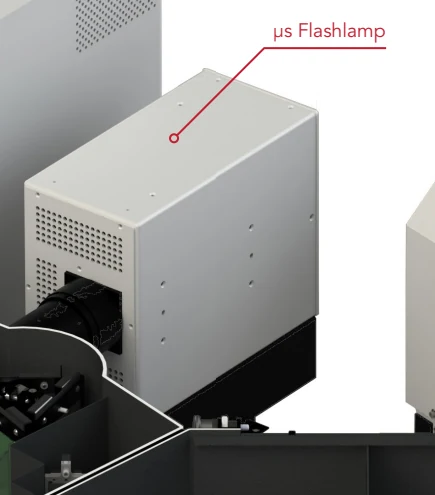
Pulsed xenon microsecond flashlamp producing high irradiance optical pulses of a few microseconds at repetition rates up to 100 Hz. The higher energy per pulse compared with the µF1 makes it the source for phosphorescence decay measurements from microseconds to seconds on the FLS1000.
Selected manufacturer specifications
| Parameter | Value |
|---|---|
| Lamp power | 60 W |
| Source type | Pulsed xenon microsecond flashlamp |
| Maximum repetition rate | 100 Hz |
Selected manufacturer data. Wavelength, pulse mode, gas fill, optical alignment and connected spectrometer must match the selected configuration; pulse-source data must not be applied to a continuous-wave lamp. Checked 2026-09-29.
Confirm your configuration
Share the details you know so we can prepare a comparable, itemised offer.
- Sample type, measurement method and required spectral/time range
- Source/laser, detector, resolution, sample holder and optical interfaces
- Software, laser safety/site requirements, calibration and application training
Get a Quote
Request an itemised quotation covering the proposed configuration, availability, lead time and agreed supply and support scope.
Useful details to share
- Materials, sample dimensions and process or measurement goal
- Required performance and existing instrument interfaces
Share what you know. You can start with your name and a phone number or email; final specifications can follow.
Not sure which configuration you need? Help me choose
Contact Vvon Technologies Limited about Edinburgh Instruments equipment requirements in Bangladesh.
Phone: +8801805987890 | Email: info@vvon.com.bd
More from Laser Systems
- nF920: Ultrafast Nanosecond Flashlamp
Thyratron triggered all metal pulsed flashlamp filled with hydrogen or nitrogen, producing sub-nanosecond optical pulses for time resolved fluorescence. Because it is a lamp rather than a laser it gives continuous wavelength selection through the excitation monochromator, covering decays from 100 picoseconds to 50 microseconds.
- µF1: 5 W Microsecond Flashlamp
Pulsed xenon microsecond flashlamp for the FS5 spectrometer, giving phosphorescence and long lifetime measurement in multi channel scaling mode from below 10 microseconds to 10 seconds. It fits the FS5 only.
- Filter VUV Light Source
Filter based vacuum ultraviolet excitation accessory consisting of a deuterium lamp, power supply and magnesium fluoride window, providing excitation around 160 nm. Filter options select the excitation band. It is used for scintillator and phosphor work where excitation must be below the range of a normal xenon source.