M16/KIT: Electric Networks Kit
Brand: EDIBON | Category: Scientific & Laboratory Equipment
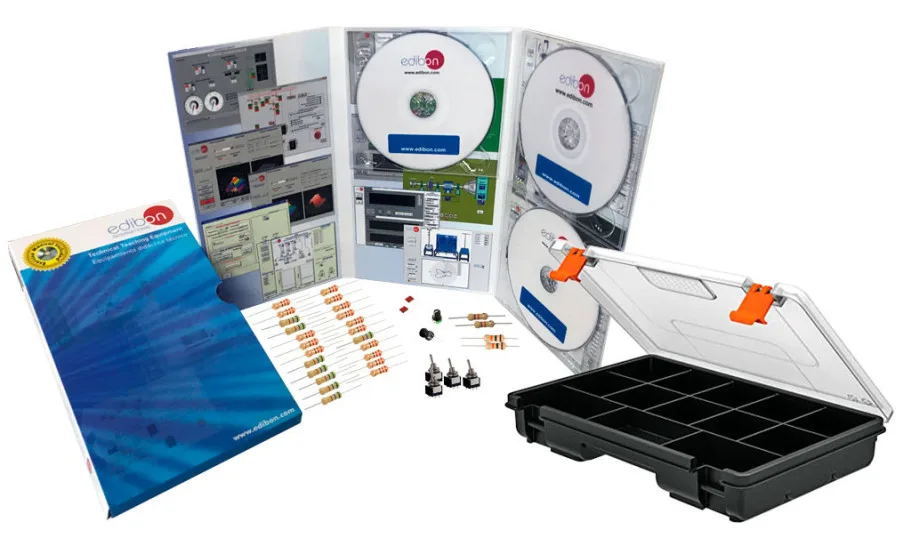
Designed by EDIBON, the Electric Networks Kit, "M16/KIT", makes it possible to understand the principles of Ohm's Law, Norton's and Thévenin's Theorem, Wheatstone bridge operation, superposition theorems or star/delta transformation and viceversa.
Published installation data
| Parameter | Value |
|---|---|
| Kit dimensions | 300 × 300 × 200 mm approx. |
| Kit weight | 500 g approx. |
| Required separately | FACO power supply and N-M15 development module |
Manufacturer kit panel for M16/KIT, page 22. Dimensions and weight are approximate; FACO and N-M15 are listed as required equipment not included with the kit. The optional EDAS/VIS acquisition system has its own ratings and is not treated as a kit specification. Confirm the current component list and workstation configuration. Confirm operating specifications, base equipment, utilities and supplied accessories in the quotation. Checked 2026-09-29.
Manufacturer reference document (opens in a new tab)
Confirm your configuration
Share the details you know so we can prepare a comparable, itemised offer.
- Basic electronics experiments, syllabus and number of student workstations
- Required base unit, modules, sensors, control/data-acquisition software and accessories
- Bench/floor space, utilities, practical manuals and faculty training
Get a Quote
Request an itemised quotation covering the proposed configuration, availability, lead time and agreed supply and support scope.
Useful details to share
- Intended application, process or teaching activity
- Required capability and equipment it must work with
Share what you know. You can start with your name and a phone number or email; final specifications can follow.
Not sure which configuration you need? Help me choose
Contact Vvon Technologies Limited about EDIBON equipment requirements in Bangladesh.
Phone: +8801805987890 | Email: info@vvon.com.bd
Back to Scientific & Laboratory Equipment
More from Basic Electronics Lab
- M18/KIT: Three-phase Circuits Kit
The generation of three-phase systems, load balancing between phases and the operation of three-phase rectifiers, etc., can be studied using the Three-phase Circuits Kit, "M18/KIT", designed by EDIBON.
- M14/KIT: Optoelectronics Kit
Designed by EDIBON, the Optoelectronics Kit, "M14/KIT", allows the study of the main light emitters and liquid crystal displays (LCD), photoconductive cells, fibre optics, infrared, etc.
- M2/KIT: Alternating Current (AC) Circuits Kit
Designed by EDIBON, the Alternating Current (AC) Circuits Kit, "M2/KIT", provides a starting point for the study of the basic principles in alternating current.