MINI-EESTC: Computer Controlled Thermal Solar Energy Basic Unit
Brand: EDIBON | Category: Scientific & Laboratory Equipment
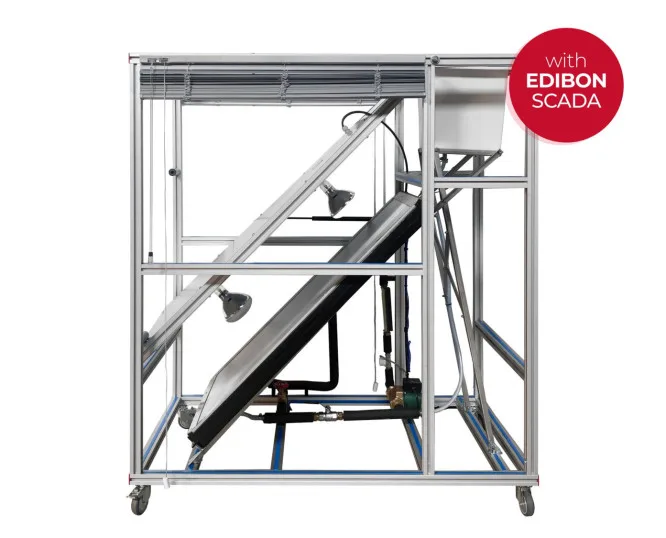
Designed by EDIBON, the Computer Controlled Thermal Solar Energy Basic Unit, "MINI-EESTC", illustrates solar thermal heating of domestic water.
Published installation data
| Parameter | Value |
|---|---|
| Electrical supply | single-phase 200 VAC – 240 VAC/50 Hz or 110 VAC – 127 VAC/60 Hz |
| Unit / Dimensions | 1300 x 800 x 1500 mm approx |
| Unit / Weight | 70 Kg approx |
| Control-Interface Box: / Dimensions | 490 x 330 x 310 mm approx |
| Control-Interface Box: / Weight | 10 Kg approx |
Selected installation data from the manufacturer brochure for MINI-EESTC, pages 5. Dimensions and weights are approximate. These values describe the named unit or component; they do not establish which accessories are included. Confirm operating specifications, utilities and the complete supplied configuration in the current quotation. Checked 2026-09-29.
Manufacturer reference document (opens in a new tab)
Confirm your configuration
Share the details you know so we can prepare a comparable, itemised offer.
- Solar pv experiments, syllabus and number of student workstations
- Required base unit, modules, sensors, control/data-acquisition software and accessories
- Bench/floor space, utilities, practical manuals and faculty training
Get a Quote
Request an itemised quotation covering the proposed configuration, availability, lead time and agreed supply and support scope.
Useful details to share
- Intended application, process or teaching activity
- Required capability and equipment it must work with
Share what you know. You can start with your name and a phone number or email; final specifications can follow.
Not sure which configuration you need? Help me choose
Contact Vvon Technologies Limited about EDIBON equipment requirements in Bangladesh.
Phone: +8801805987890 | Email: info@vvon.com.bd
Back to Scientific & Laboratory Equipment
More from Solar PV Lab
- EESFB: Photovoltaic Solar Energy Unit
Photovoltaic teaching unit with its own solar simulator, so the direct conversion of light into electricity can be studied indoors. Students plot I-V and P-V curves, measure open circuit voltage and short circuit current and study the effect of temperature.
- EESTC: Computer Controlled Thermal Solar Energy Unit
The Computer Controlled Thermal Solar Energy Unit, "EESTC", is a system for transforming solar energy into usable thermal energy. Water can be heated using either the thermosiphon solar system or the traditional pumping system.
- MINI-EESF: Photovoltaic Solar Energy Modular Unit (Complete Version)
Laboratory scale modular unit for studying the parameters involved in converting solar radiation into electricity. Application modules and panels on mobile structures cover battery charging, DC loads, AC loads through an inverter and injection into the public grid.