QRD: Batch Reactor for QR
Brand: EDIBON | Category: Scientific & Laboratory Equipment
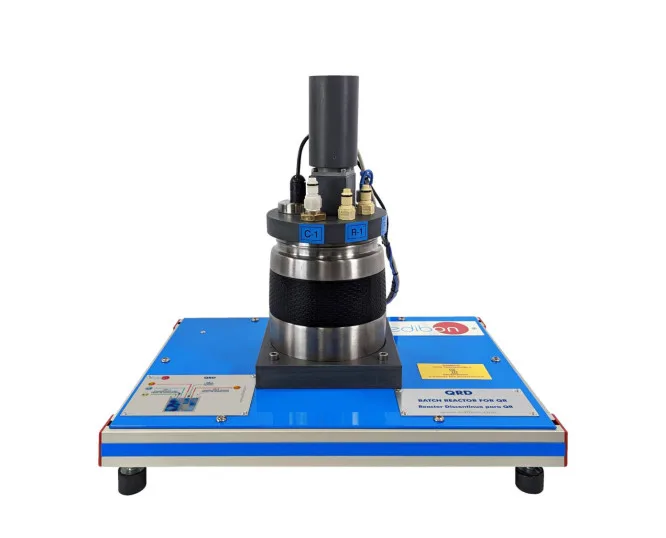
Designed by EDIBON, the Batch Reactor for QR, "QRD", supports the study and kinetic analysis of homogeneous liquid-liquid reactions, together with the demonstration of adiabatic and isothermal reactions.
Published installation data
| Parameter | Value |
|---|---|
| Unit dimensions | 330 × 330 × 500 mm approx. |
| Unit weight | 10 kg approx. |
Selected installation data for QRD from the manufacturer brochure, page 11. Dimensions and weight are approximate and refer to this named unit or module, not the complete laboratory. Confirm operating specifications, base equipment, utilities and supplied accessories in the quotation. Checked 2026-09-29.
Manufacturer reference document (opens in a new tab)
Confirm your configuration
Share the details you know so we can prepare a comparable, itemised offer.
- Chemical engineering experiments, syllabus and number of student workstations
- Required base unit, modules, sensors, control/data-acquisition software and accessories
- Bench/floor space, utilities, practical manuals and faculty training
Get a Quote
Request an itemised quotation covering the proposed configuration, availability, lead time and agreed supply and support scope.
Useful details to share
- Intended application, process or teaching activity
- Required capability and equipment it must work with
Share what you know. You can start with your name and a phone number or email; final specifications can follow.
Not sure which configuration you need? Help me choose
Contact Vvon Technologies Limited about EDIBON equipment requirements in Bangladesh.
Phone: +8801805987890 | Email: info@vvon.com.bd
Back to Scientific & Laboratory Equipment
More from Chemical Engineering Lab
- QRDC: Computer Controlled Batch Reactor for QRC
Designed by EDIBON, the Computer Controlled Batch Reactor for QRC, "QRDC", supports the study and kinetic analysis of homogeneous liquid-liquid reactions, together with the demonstration of adiabatic and isothermal reactions. From sensor calibration to the formulation of velocity equations and the determination of ionic conductivities, this unit offers many opportunities for investigating reaction kinetics.
- QRCC-IF: Computer Controlled Flow Injection Analysis (FIA) Unit
Recommended for use with the "QRCC" unit, the Computer Controlled Flow Injection Analyzer (FIA), "QRCC-IF", is an additional element that allows continuous measurement of the degree of conversion in the sucrose hydrolysis reaction.
- QRFT: Tubular Flow Reactor
Designed specifically by EDIBON, the Tubular Flow Reactor, "QRFT", is intended for the kinetic study of liquid-liquid homogeneous reactions. Practices with this unit range widely, including determining kinetic equations, calculating kinetic constants and their variation with temperature, and comparing the reactor's theoretical and experimental conversion values.