TICC: Computer Controlled Heat Exchangers Training System
Brand: EDIBON | Category: Scientific & Laboratory Equipment
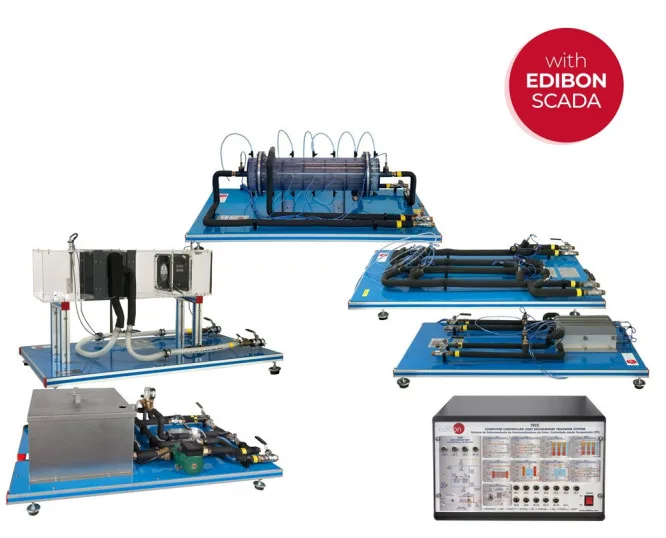
Designed by EDIBON, the "TICC" Computer Controlled Heat Exchangers Training System is used to study and compare different types of small-scale heat exchangers working in parallel or counterflow arrangements.
Published base-unit installation data
| Parameter | Value |
|---|---|
| TIUS base-unit dimensions | 1,100 × 630 × 500 mm, approximately |
| TIUS base-unit weight | 50 kg, approximately |
| Separate control-interface box | 490 × 330 × 310 mm; 10 kg, approximately |
These figures describe the named base unit and separate control interface only. Select the experiment modules separately; the complete laboratory footprint and total weight depend on the ordered configuration. Checked 2026-09-29.
Manufacturer reference document (opens in a new tab)
Confirm your configuration
Share the details you know so we can prepare a comparable, itemised offer.
- Heat transfer experiments, syllabus and number of student workstations
- Required base unit, modules, sensors, control/data-acquisition software and accessories
- Bench/floor space, utilities, practical manuals and faculty training
Get a Quote
Request an itemised quotation covering the proposed configuration, availability, lead time and agreed supply and support scope.
Useful details to share
- Intended application, process or teaching activity
- Required capability and equipment it must work with
Share what you know. You can start with your name and a phone number or email; final specifications can follow.
Not sure which configuration you need? Help me choose
Contact Vvon Technologies Limited about EDIBON equipment requirements in Bangladesh.
Phone: +8801805987890 | Email: info@vvon.com.bd
Back to Scientific & Laboratory Equipment
More from Heat Transfer Lab
- TICF: Cross Flow Heat Exchanger for TICC
Designed by EDIBON, the "TICF" Cross-Flow Heat Exchanger for TICC provides an effective tool for thermal research, enabling the study of heat transfer between two fluids in a cross-flow configuration.
- TFLVC: Computer Controlled Laminar/Viscous Flow Heat Transfer Unit
Designed by EDIBON, the "TFLVC" Computer Controlled Laminar/Viscous Flow Heat Transfer Unit was created to study heat transfer between hot oil flowing in laminar flow through an internal tube and cold water flowing through the annulus (ring-shaped area) between the internal and external tubes.
- TICFB: Cross Flow Heat Exchanger for TICB
Designed by EDIBON, the "TICFB" Cross-Flow Heat Exchanger for TICB provides an effective tool for thermal research, enabling the study of heat transfer between two fluids in a cross-flow configuration. Here, a stream of hot water from the base unit interacts with an airflow generated by a fan through a perpendicular radiator.