TruCorr Attenuation Correction
Brand: Spectrum Dynamics Medical | Category: Nuclear Medicine & Imaging
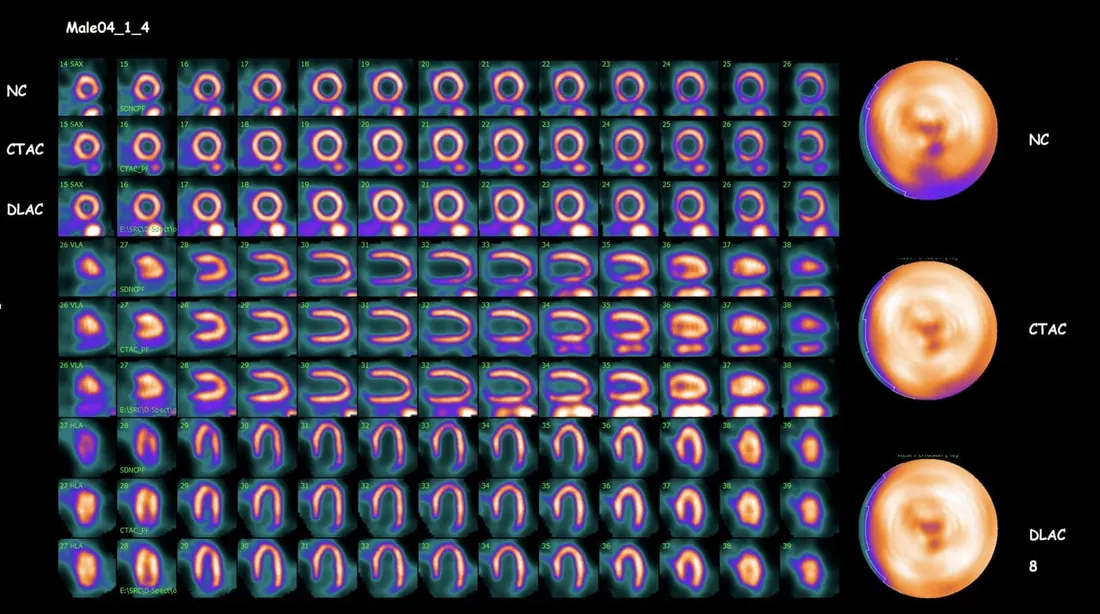
Deep learning attenuation correction for myocardial perfusion imaging on the D-SPECT. A convolutional neural network works from the patient's own SPECT emission data in a single acquisition, so no CT or Gd-153 transmission scan is needed to produce a corrected data set.
Technical Specifications
| Parameter | Value |
|---|---|
| Specification | Deep learning attenuation correction (DLAC) based on a convolutional neural network |
| Specification | Uses SPECT emission data from one acquisition, no CT or Gd-153 transmission scan |
| Specification | No additional time beyond standard D-SPECT clinical protocols |
| Specification | Runs from the TruSPECT workstation inside the existing MPI workflow |
| Specification | Works with supine and upright patient positioning |
| Specification | Results reviewed in cardiac analysis software such as 4DM or Cedars |
Get a Quote
Request an itemised quotation covering the proposed configuration, availability, lead time and agreed supply and support scope.
Useful details to share
- Department workflow and intended equipment use
- Required configuration and existing system interfaces
Share what you know. You can start with your name and a phone number or email; final specifications can follow.
Not sure which configuration you need? Help me choose
Contact Vvon Technologies Limited about Spectrum Dynamics Medical equipment requirements in Bangladesh.
Phone: +8801805987890 | Email: info@vvon.com.bd
Back to Nuclear Medicine & Imaging
More from Imaging & QA Software
- Veritas.AI Noise Reduction
Deep learning noise reduction for the VERITON-CT digital SPECT/CT. It reduces image noise without giving up spatial resolution or quantitative accuracy, which supports faster acquisitions and lower administered activity. Spectrum Dynamics state that it holds FDA 510(k) clearance.
- FUSION Software
Multi modality image fusion for SPECT, PET and CT studies from hybrid or standalone systems. The registration methods work automatically and handle rigid and non linear patient movement, and Hounsfield unit windowing with selectable colour scales controls the display.
- TruClear.AI Noise Reduction
Deep learning noise reduction for myocardial perfusion imaging on the D-SPECT. It reduces statistical noise in low count acquisitions and returns clear perfusion and gated reconstructions, so image quality holds up when scan time or administered activity is cut back.