AZtecLiveOne
Brand: Oxford Instruments | Category: Nanotechnology
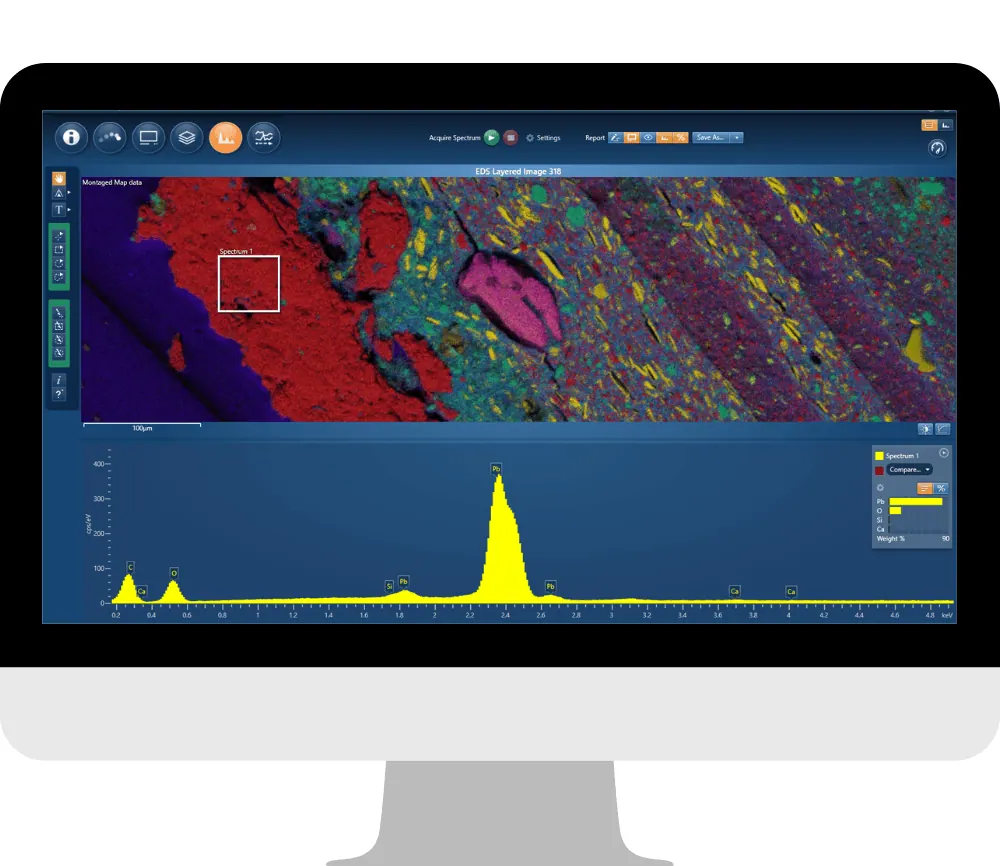
AZtecLiveOne is a simplified energy dispersive X-ray software platform for users without detailed training in the technique. It is aimed at multi user laboratories where operators need dependable results quickly and can be brought up to speed in minutes.
Published software capabilities
| Parameter | Value |
|---|---|
| Acquisition tools | Live chemical imaging, spectra, X-ray mapping and line scans |
| Quantification | Tru-Q element identification and quantitative analysis |
| Optional map correction | TruMap |
Selected manufacturer data for the named configuration. Optical, detector and sample-environment options are ordered separately unless included in the quotation. Measurement results depend on the sample, selected components and operating conditions. Checked 2026-09-29.
Confirm your configuration
Share the details you know so we can prepare a comparable, itemised offer.
- Installed instrument/controller and software version to be supported
- Required analysis modules, licence term, number of users and data export
- Computer requirements, installation, training and update/support entitlement
Get a Quote
Request an itemised quotation covering the proposed configuration, availability, lead time and agreed supply and support scope.
Useful details to share
- Materials, sample dimensions and process or measurement goal
- Required performance and existing instrument interfaces
Share what you know. You can start with your name and a phone number or email; final specifications can follow.
Not sure which configuration you need? Help me choose
Contact Vvon Technologies Limited about Oxford Instruments equipment requirements in Bangladesh.
Phone: +8801805987890 | Email: info@vvon.com.bd
More from Instrument Software
- AZtecOne
AZtecOne is a complete energy dispersive X-ray system pairing the AZtecOne software with the Xplore detector. It is built for laboratories that need straightforward elemental analysis without substantial operator training, and suits shared multi user instruments.
- AZtec Suite 6.3
AZtec Suite 6.3 is the current release of the Oxford Instruments acquisition and processing platform for EDS, EBSD, BEX and RISE systems. It adds batch export and HTML reporting, a RISE navigator, magic wand area selection, new AutoPhaseMap and further detector safety.
- AZtecHKL
AZtecHKL is the Oxford Instruments electron backscatter diffraction acquisition software. It carries out data collection and analysis in real time, drives the Symmetry S3 detector, and is set up for nanoscale orientation mapping by transmission Kikuchi diffraction.