Cardiac First-Pass
Brand: MiE GmbH | Category: Nuclear Medicine & Imaging
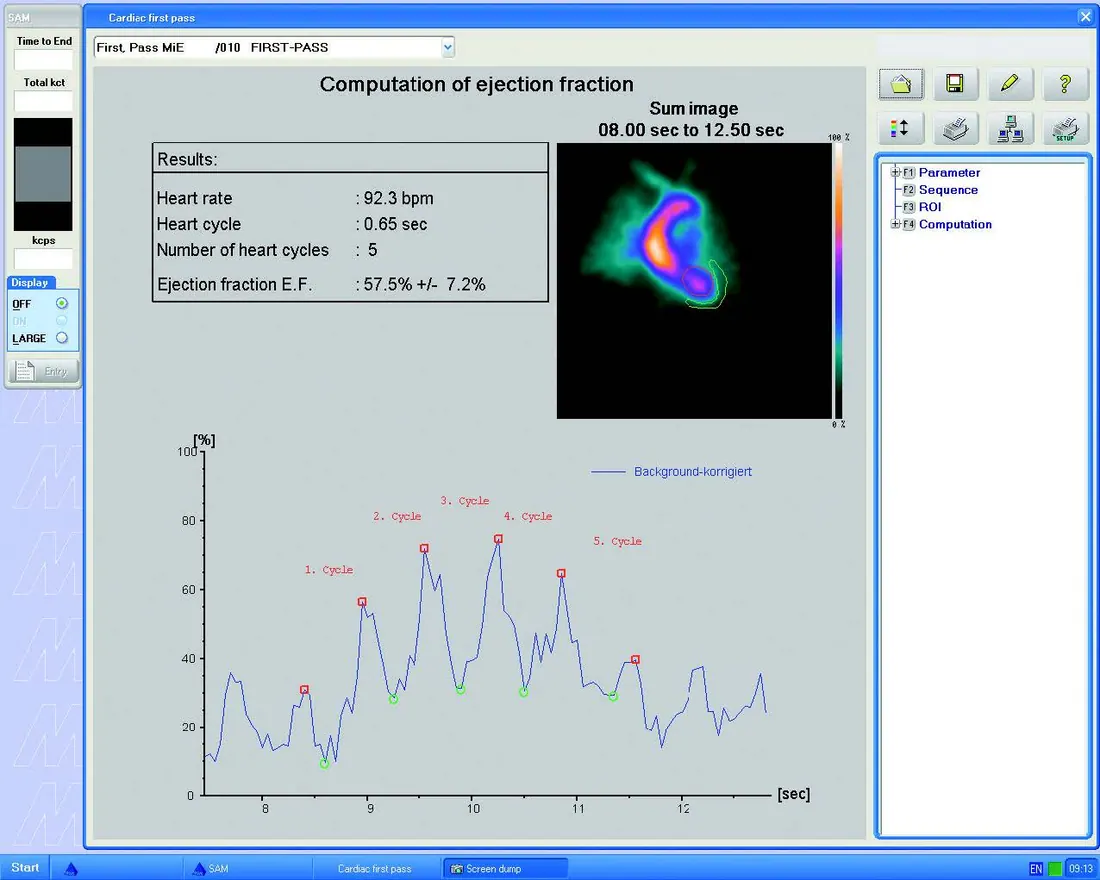
A SCINTRON planar program for first pass studies of the heart, acquired while a bolus of high activity is still inside one ventricle. Working from high speed dynamic frames it avoids the background and overlap problems of multi gated studies, and computes ejection fraction, heart rate and cycle length.
Technical Specifications
| Parameter | Value |
|---|---|
| Specification | High speed dynamic frame mode acquisition at 20 frames per second |
| Specification | Acquisition while the bolus is completely in the left or right ventricle |
| Specification | Zoomable time activity curve display |
| Specification | Definable sum image for entry of heart and background regions of interest |
| Specification | Selection of optimal cycles |
| Specification | Computation of ejection fraction, heart frequency and heart cycle |
Get a Quote
Request an itemised quotation covering the proposed configuration, availability, lead time and agreed supply and support scope.
Useful details to share
- Department workflow and intended equipment use
- Required configuration and existing system interfaces
Share what you know. You can start with your name and a phone number or email; final specifications can follow.
Not sure which configuration you need? Help me choose
Contact Vvon Technologies Limited about MiE GmbH equipment requirements in Bangladesh.
Phone: +8801805987890 | Email: info@vvon.com.bd
Back to Nuclear Medicine & Imaging
More from Imaging & QA Software
- Deconvolution
A SCINTRON processing option that improves the signal to noise ratio of planar studies using standardised parameters, so contours are displayed more sharply. MiE make it available for the Bone, WholeBody and Multidisplay programs, and the result can be read against the raw data side by side.
- TruFlow Dynamic Imaging
Dynamic SPECT software for the D-SPECT, including myocardial blood flow assessment. It uses list mode acquisition with flexible reconstruction to support traditional and fast dynamic protocols, and passes results to established quantitative analysis tools.
- DYNAX - Renal Scintigraphy
A SCINTRON program for quantitative analysis of dynamic studies. For renal work it determines side ratios, calculates counts and region sizes, and shows renal function as curves. The same program handles salivary gland studies, giving uptake before irritation and the excretion fraction.