LDH Series
Brand: PicoQuant | Category: Nanotechnology
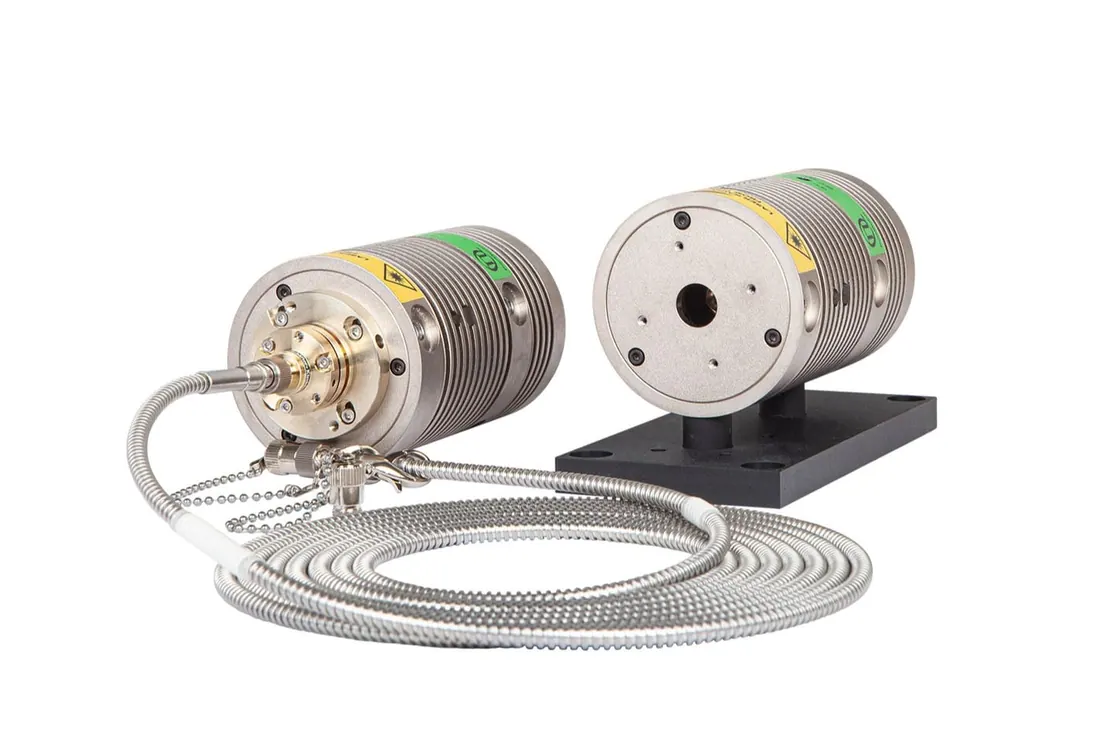
The LDH Series are picosecond pulsed laser diode heads covering a broad range of wavelengths. The beam optics use a numerical aperture of 0.55, with typical divergence of 0.11 mrad and 0.32 mrad along the two beam axes and typically linear polarisation. They are used for time-resolved techniques and LiDAR.
Technical Specifications
| Parameter | Value |
|---|---|
| Optics focus length | f' = 4.5 mm (typ. for LDH-P/D-C-xxx), f' = 9.0 mm (typ. for LDH-D-TA-xxx) |
| Numerical aperture | 0.55 |
| Typical divergence with optics | Theta parallel typ. 0.11 mrad, Theta perpendicular typ. 0.32 mrad |
| Polarization | typ. linear, perpendicular to the longer axis of the elliptical beam |
| Spectral width | approx. 2-8 nm for wavelengths < 900 nm, approx. 10-20 nm for wavelengths > 900 nm, < 1 nm in CW operation |
| Power stability (cooled), 12 hours | 1 % RMS, 3 % peak to peak |
Get a Quote
Request an itemised quotation covering the proposed configuration, availability, lead time and agreed supply and support scope.
Useful details to share
- Materials, sample dimensions and process or measurement goal
- Required performance and existing instrument interfaces
Share what you know. You can start with your name and a phone number or email; final specifications can follow.
Not sure which configuration you need? Help me choose
Contact Vvon Technologies Limited about PicoQuant equipment requirements in Bangladesh.
Phone: +8801805987890 | Email: info@vvon.com.bd
More from Photoluminescence & Time-Resolved Spectroscopy
- LDH-I Series
The LDH-I Series are smart picosecond laser diode heads covering the UV-A to the near infrared. They provide high power at high repetition rates, with a numerical aperture of 0.55 and a spectral width of about 2 to 8 nm below 900 nm. They are used for time-resolved methods including FLIM and TRPL.
- PDA-23
The PDA-23 is a cooled 23-pixel single photon avalanche diode array detector. It provides low-noise, high-efficiency single photon detection across all 23 pixels for imaging and time-correlated single photon counting. Reported uses include fluorescence correlation spectroscopy with SPAD arrays.
- LDH-FA Series
The LDH-FA Series are fibre amplified picosecond laser diode heads delivering high pulse energy and stable output. Configurations cover UV, visible and infrared wavelengths, and optional fibre coupling is available for beam delivery. They are used for time-resolved techniques and for LiDAR.