M99-6: Electronics for Motors and Generators Unit
Brand: EDIBON | Category: Scientific & Laboratory Equipment
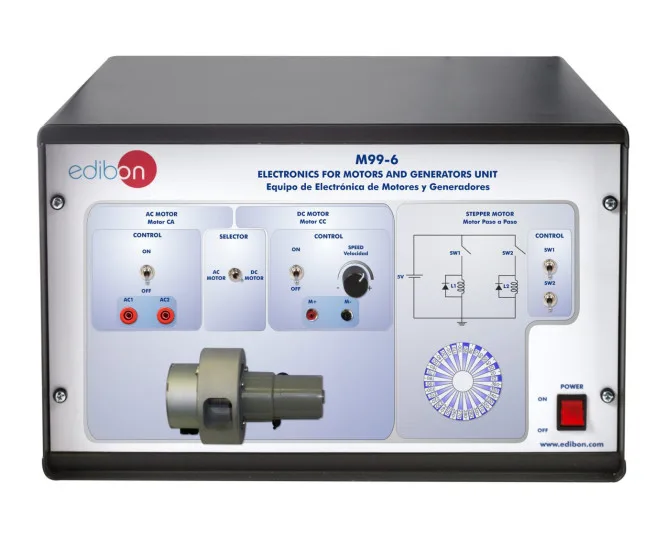
Designed by EDIBON, the Electronics for Motors and Generators Unit, "M99-6", lets the student learn the most important concepts related to motors and generators, along with the differences between them.
Published installation data
| Parameter | Value |
|---|---|
| Electrical supply | single-phase 200 VAC – 240 VAC/50 Hz or 110 VAC – 127 VAC/60 Hz |
| Dimensions | 490 x 330 x 310 mm approx |
| Weight | 6 kg approx |
Selected installation data from the manufacturer brochure for M99-6, pages 2. Dimensions and weights are approximate. These values describe the named unit or component; they do not establish which accessories are included. Confirm operating specifications, utilities and the complete supplied configuration in the current quotation. Checked 2026-09-29.
Manufacturer reference document (opens in a new tab)
Confirm your configuration
Share the details you know so we can prepare a comparable, itemised offer.
- Basic electronics experiments, syllabus and number of student workstations
- Required base unit, modules, sensors, control/data-acquisition software and accessories
- Bench/floor space, utilities, practical manuals and faculty training
Get a Quote
Request an itemised quotation covering the proposed configuration, availability, lead time and agreed supply and support scope.
Useful details to share
- Intended application, process or teaching activity
- Required capability and equipment it must work with
Share what you know. You can start with your name and a phone number or email; final specifications can follow.
Not sure which configuration you need? Help me choose
Contact Vvon Technologies Limited about EDIBON equipment requirements in Bangladesh.
Phone: +8801805987890 | Email: info@vvon.com.bd
Back to Scientific & Laboratory Equipment
More from Basic Electronics Lab
- N-M1: Direct Current (DC) Circuits Module
A bench module for the fundamentals of direct current, covering Ohm's law, resistor characteristics, series and parallel association, the Wheatstone bridge and Kirchhoff's laws. Faults can be introduced into most circuits so students diagnose why the circuit stops working properly.
- N-M15: Own Development Module
Designed by EDIBON, the Own Development Module "N-M15" consists of a circuit board. The board allows a set of assemblies to be carried out on it, supporting the study of the basic concepts of direct current circuits.
- N-M18: Three-phase Circuits Module
Covers how three-phase systems are generated and measured, including star and delta connection, balanced and unbalanced loads, line and phase quantities, and three-phase rectification. Fault simulation on the circuit blocks lets students trace and explain abnormal behaviour.