Model 336 Cryogenic Temperature Controller
Brand: Lake Shore | Category: Nanotechnology
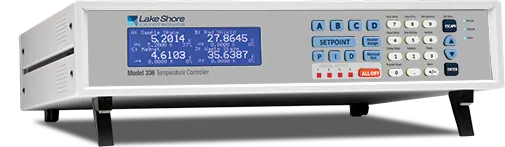
The Model 336 is a cryogenic temperature controller with four sensor inputs and four PID controlled outputs, and it controls temperature down to 300 mK. It reads diode, RTD and thermocouple sensors, with scanner, thermocouple and capacitance option cards available for added inputs.
Technical Specifications
| Parameter | Value |
|---|---|
| Diode input ranges | 0 V to 2.5 V and 0 V to 10 V, 10 µA +/-0.05% excitation |
| PTC RTD input ranges | 0 Ω to 10 Ω through 0 Ω to 10 kΩ, 1 mA excitation |
| NTC RTD input ranges | 0 Ω to 10 Ω through 0 Ω to 100 kΩ, excitation from 1 mA down to 100 nA |
| Thermocouple option Model 3060-F | +/-50 mV range, electronic accuracy +/-4.5 µV +/-0.07% of rdg at 25 °C |
| Scanner option | Model 3062 |
| Capacitance option | Model 3061 |
Get a Quote
Request an itemised quotation covering the proposed configuration, availability, lead time and agreed supply and support scope.
Useful details to share
- Materials, sample dimensions and process or measurement goal
- Required performance and existing instrument interfaces
Share what you know. You can start with your name and a phone number or email; final specifications can follow.
Not sure which configuration you need? Help me choose
Contact Vvon Technologies Limited about Lake Shore equipment requirements in Bangladesh.
Phone: +8801805987890 | Email: info@vvon.com.bd
More from Cryogenics & Temperature Control
- Model 346 Cryogenic Temperature Controller
The Model 346 is a cryogenic temperature controller with 10 sensor inputs in its base configuration, expandable to 26 inputs using option cards. It covers 300 mK to 1500 K and provides 400 W of total heater power. It is used to measure and control temperature across several zones at once.
- Model 335 Cryogenic Temperature Controller
The Model 335 is a cryogenic temperature controller with two sensor inputs that reads diodes, resistance sensors and thermocouples down to 300 mK. Its resistance ranges span 0 Ω to 100 kΩ with excitation from 1 mA down to 100 nA. It is used to measure and control cryostat temperature.
- Model 350 Cryogenic Temperature Controller
The Model 350 is a cryogenic temperature controller for very low temperature platforms, including helium-3 systems, and works down to 100 mK. Its resistance inputs cover 0 Ω to 300 kΩ with excitation currents down to 10 nA. It is used to measure and control cryostat temperature.