PMA Hybrid Series
Brand: PicoQuant | Category: Nanotechnology
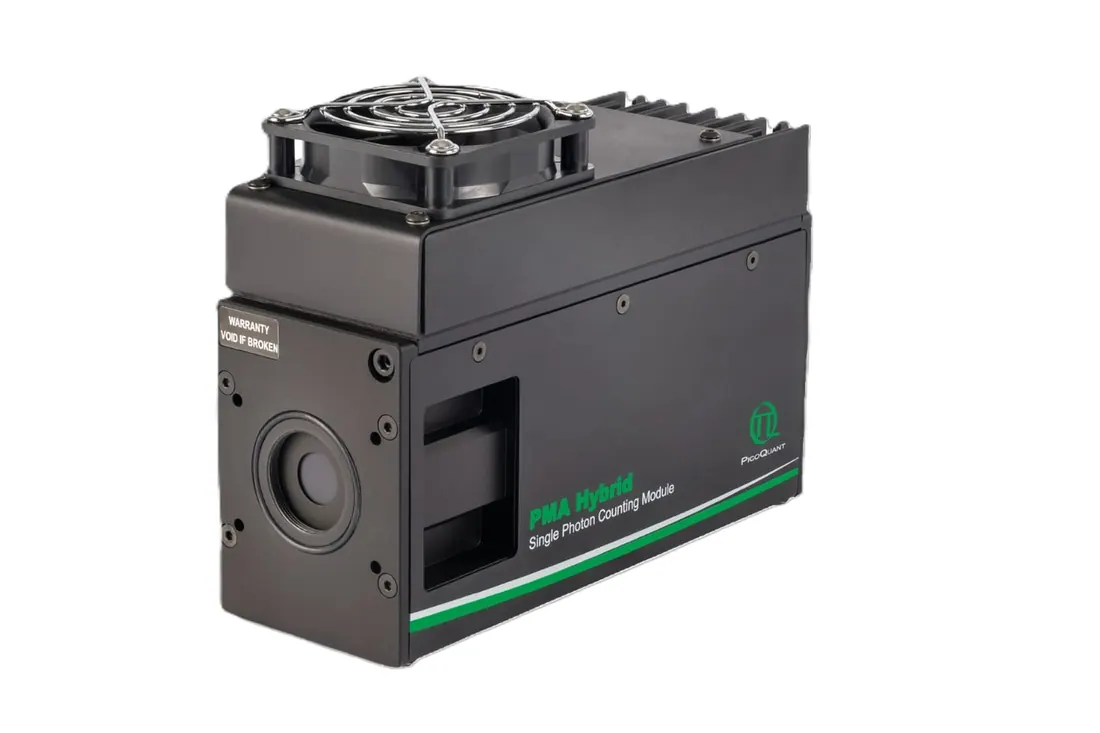
The PMA Hybrid Series are hybrid photomultiplier detector assemblies for single photon counting from the UV to the near infrared. Depending on the cathode type they cover ranges between 220 nm and 890 nm, with cooled dark counts as low as 10 cps typical. Separate timing and analogue outputs are provided.
Technical Specifications
| Parameter | Value |
|---|---|
| Wavelength ranges (cathode dependent) | 220 to 650 nm, 220 to 850 nm, 300 to 720 nm, 300 to 870 nm, 380 to 890 nm |
| Cathode types | 06, 07 (3 mm), 07 (6 mm), 40 (3 mm), 40 (5 mm) |
| Dark counts (cooled) | typ. 10 cps | max. 20 cps, or typ. 100 cps | max. 250 cps depending on cathode type |
| Signal output (timing) | SMA female, 50 Ohms, negative polarity |
| Signal output (analog) | SMA female, > 1k Ohms, max. out +10 V (corresponds to 50 Mcps) |
| Power supply | 12 V DC input, max. current consumption 0.8 A |
Get a Quote
Request an itemised quotation covering the proposed configuration, availability, lead time and agreed supply and support scope.
Useful details to share
- Materials, sample dimensions and process or measurement goal
- Required performance and existing instrument interfaces
Share what you know. You can start with your name and a phone number or email; final specifications can follow.
Not sure which configuration you need? Help me choose
Contact Vvon Technologies Limited about PicoQuant equipment requirements in Bangladesh.
Phone: +8801805987890 | Email: info@vvon.com.bd
More from Photoluminescence & Time-Resolved Spectroscopy
- PDM Series
The PDM Series are single photon avalanche diode detectors for time-resolved measurements. Photon detection efficiency reaches 49 % at 550 nm, timing resolution goes down to 50 ps FWHM on the NIM timing output and dead time is typically 77 ns. They are used for FLIM, TRPL and LiDAR.
- PMA Series
The PMA Series are integrated photomultiplier detector assemblies for time-correlated single photon counting. The PMA 175 covers 230 to 700 nm and the PMA 192 covers 230 to 920 nm, both with transit time spread below 180 ps. Cooled versions lower the dark count rate for work on weak signals.
- PDA-23
The PDA-23 is a cooled 23-pixel single photon avalanche diode array detector. It provides low-noise, high-efficiency single photon detection across all 23 pixels for imaging and time-correlated single photon counting. Reported uses include fluorescence correlation spectroscopy with SPAD arrays.