TEPGC: Computer Controlled Expansion Processes of a Perfect Gas Unit
Brand: EDIBON | Category: Scientific & Laboratory Equipment
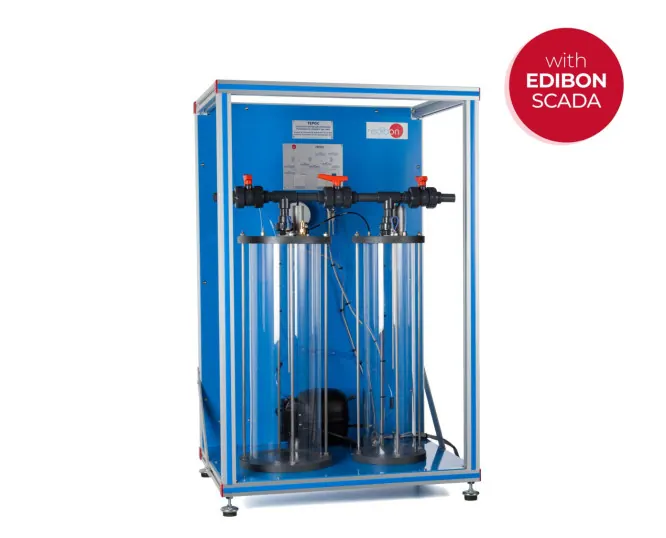
Two connected methacrylate vessels, one pressurised and one under vacuum, used to demonstrate expansion and compression of a perfect gas. Fast and slow expansions are compared, giving practical work on the first and second laws of thermodynamics.
Technical Specifications
| Parameter | Value |
|---|---|
| Specification | Two rigid methacrylate vessels, one pressurised and one vacuum, with a computer controlled air pump |
| Specification | Large diameter pipe with quick acting valve for fast expansions |
| Specification | Small diameter pipe with needle regulation valve for slow expansions |
| Specification | Pressure and temperature sensors on both vessels plus ambient condition sensors |
| Specification | Gauged overpressure safety valve on the pressurised vessel |
| Specification | Supplied with EDIBON SCADA computer control, data acquisition and data management software |
Get a Quote
Request an itemised quotation covering the proposed configuration, availability, lead time and agreed supply and support scope.
Useful details to share
- Intended application, process or teaching activity
- Required capability and equipment it must work with
Share what you know. You can start with your name and a phone number or email; final specifications can follow.
Not sure which configuration you need? Help me choose
Contact Vvon Technologies Limited about EDIBON equipment requirements in Bangladesh.
Phone: +8801805987890 | Email: info@vvon.com.bd
Back to Scientific & Laboratory Equipment
More from Thermodynamics Lab
- TLBGC: Computer Controlled Gas Laws Unit (Boyle and Gay-Lussac Laws)
Bench unit that demonstrates two fundamental gas laws using air as the test gas. One transparent vessel gives the isochoric change of state by electrical heating, the second gives the isothermal change of state using an oil piston driven by a compressor and vacuum pump.
- TECMC: Computer Controlled Marcet Boiler Unit
Marcet boiler for the experimental study of the relationship between pressure and temperature of saturated steam in equilibrium with water. Students plot the saturation curve, compare it with published steam tables and derive the Clausius Clapeyron equation.
- TSPC: Computer Controlled Saturation Pressure Unit
Water boiler with a sight glass and a throttling calorimeter, used to measure the relationship between saturation temperature and pressure and to determine the dryness fraction of the steam produced. Boiling patterns at the water surface can be observed directly.