AGILE: Tunable White Light Source
Brand: Edinburgh Instruments | Category: Nanotechnology
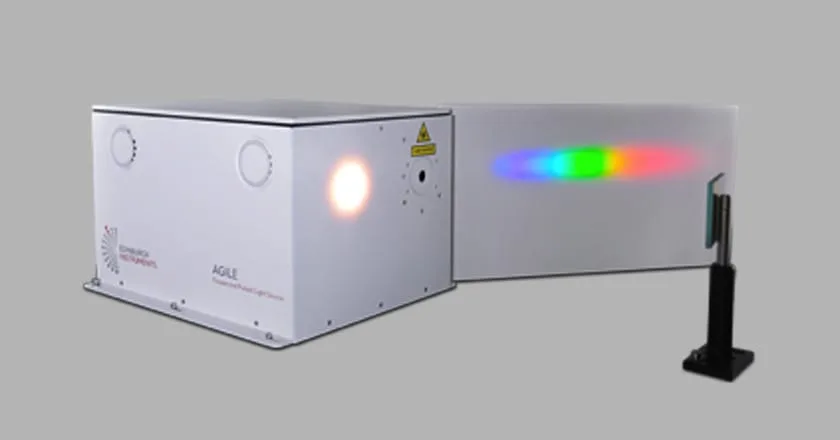
Wavelength tunable supercontinuum laser giving picosecond pulses across the visible and near infrared with a variable repetition rate, designed for time-correlated single photon counting on the FLS1000. It replaces a set of fixed wavelength diode lasers with one source that can be tuned to the sample.
Selected manufacturer specifications
| Parameter | Value |
|---|---|
| Repetition Rate | 10 kHz - 1 MHz |
| Computer Interface | USB 2.0 |
| Operating Temperature | +15°C to +30°C |
| Power | 90 - 240 VAC, 1A, ; 50/60 Hz |
| Dimensions (mm) | 410 (L) x 305 (W) x 245 (H) |
| Weight | 14 kg (approx) |
Selected Agile manufacturer data. Optical power and pulse width vary with wavelength and bandpass; use the complete wavelength table for an application-specific comparison. Checked 2026-09-29.
Confirm your configuration
Share the details you know so we can prepare a comparable, itemised offer.
- Sample type, measurement method and required spectral/time range
- Source/laser, detector, resolution, sample holder and optical interfaces
- Software, laser safety/site requirements, calibration and application training
Get a Quote
Request an itemised quotation covering the proposed configuration, availability, lead time and agreed supply and support scope.
Useful details to share
- Materials, sample dimensions and process or measurement goal
- Required performance and existing instrument interfaces
Share what you know. You can start with your name and a phone number or email; final specifications can follow.
Not sure which configuration you need? Help me choose
Contact Vvon Technologies Limited about Edinburgh Instruments equipment requirements in Bangladesh.
Phone: +8801805987890 | Email: info@vvon.com.bd
More from Laser Systems
- PL Series: CO and CO2 Gas Lasers
Continuous wave carbon dioxide and carbon monoxide gas lasers, from the 1 W sealed PL2-S up to the 180 W flowing gas PL6. Line selection ranges from 50 to 90 lines depending on model, and active stabilisation holds frequency to within a few megahertz over ten minutes. They are used in spectroscopy, non-linear optics, LIDAR and interferometry.
- VPLED Series: Variable Pulse Width Pulsed LEDs
Variable pulse width LED sources covering 255 nm to 1300 nm, a wider span than the diode laser series and reaching further into both the ultraviolet and the near infrared. They are used for phosphorescence and multi channel scaling measurements where a long excitation pulse is needed.
- MTL-5: Mini-TEA CO2 Laser
Transversely excited atmospheric pressure carbon dioxide laser delivering pulses of about 50 nanoseconds at up to 100 Hz. It is available untuned for maximum energy or tuned for line selection between 9.2 and 10.8 micrometres, in multimode or TEM00 beam quality.