BELPYCNO: Density Analyser
Brand: Microtrac MRB | Category: Scientific & Laboratory Equipment
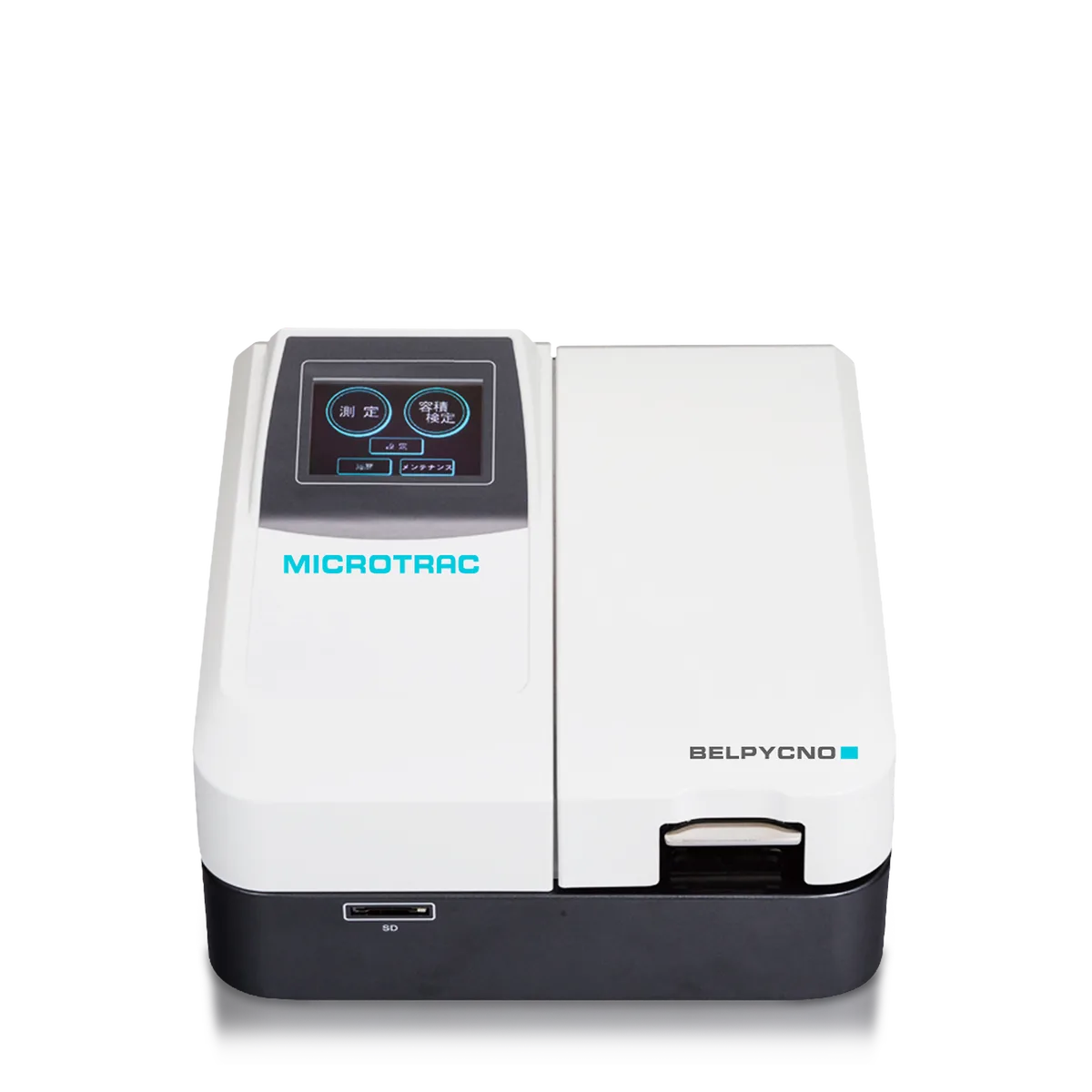
Gas pycnometer that determines true density of powders and porous solids by measuring the volume of gas that the sample displaces, so open pores are excluded from the volume. Helium is normally used because its small molecule penetrates fine pore structures.
Selected manufacturer specifications
| Parameter | Value |
|---|---|
| Sample cell volume | 10 cm3, 3.5 cm3, 1 cm3 |
| Measurement accuracy | 0.03% of F.S. +0.03% of reading |
| Repeatability | 0.02% of F.S. |
| Pretreatment pressure | 0-145kPa (Gauge) |
| Measurement pressure | 145kPa (Gauge) |
| Repetition times of measurement | Maximum 100 times |
| Mean number of measurement | Maximum 10 times |
| Measurement temperature range | 15-35°C, water bath: 15-50°C (option) |
| Dimensions (W x H x D) | 270 x 170 x 300 mm |
| Weight | 8 kg |
Selected values from the manufacturer’s technical data for this product or explicitly named model variants. Measurement performance depends on the sample and configuration. Confirm the current model, utilities, accessories and acceptance criteria in the quotation. Checked 2026-09-29.
Confirm your configuration
Share the details you know so we can prepare a comparable, itemised offer.
- Sample material, dimensions/quantity and required preparation or analysis result
- Measuring/working range, repeatability requirements and compatible accessories
- Utilities, calibration/reference materials, software and service scope
Get a Quote
Request an itemised quotation covering the proposed configuration, availability, lead time and agreed supply and support scope.
Useful details to share
- Intended application, process or teaching activity
- Required capability and equipment it must work with
Share what you know. You can start with your name and a phone number or email; final specifications can follow.
Not sure which configuration you need? Help me choose
Contact Vvon Technologies Limited about Microtrac MRB equipment requirements in Bangladesh.
Phone: +8801805987890 | Email: info@vvon.com.bd
Back to Scientific & Laboratory Equipment
More from Laboratory Instruments
- BELPYCNO L: Gas Pycnometer
Larger chamber version of the BELPYCNO gas pycnometer, for samples too bulky for the standard cell. It uses the same gas displacement principle to give true density excluding open porosity.
- BELPORE Series: Mercury Porosimeter
Mercury intrusion porosimeter that forces mercury into a porous solid under increasing pressure to derive pore size distribution and total pore volume. It covers the macropore and mesopore range that gas adsorption cannot reach, and is used on ceramics, catalysts, cements and rock.
- BELPREP VAC II: Vacuum Degasser
Vacuum degassing station that removes adsorbed moisture and gases from samples before an adsorption measurement. Incomplete degassing is the commonest source of error in BET surface area work, because residual water occupies the sites the measurement is meant to count.