DIL L78 RITA
Brand: Linseis | Category: Nanotechnology
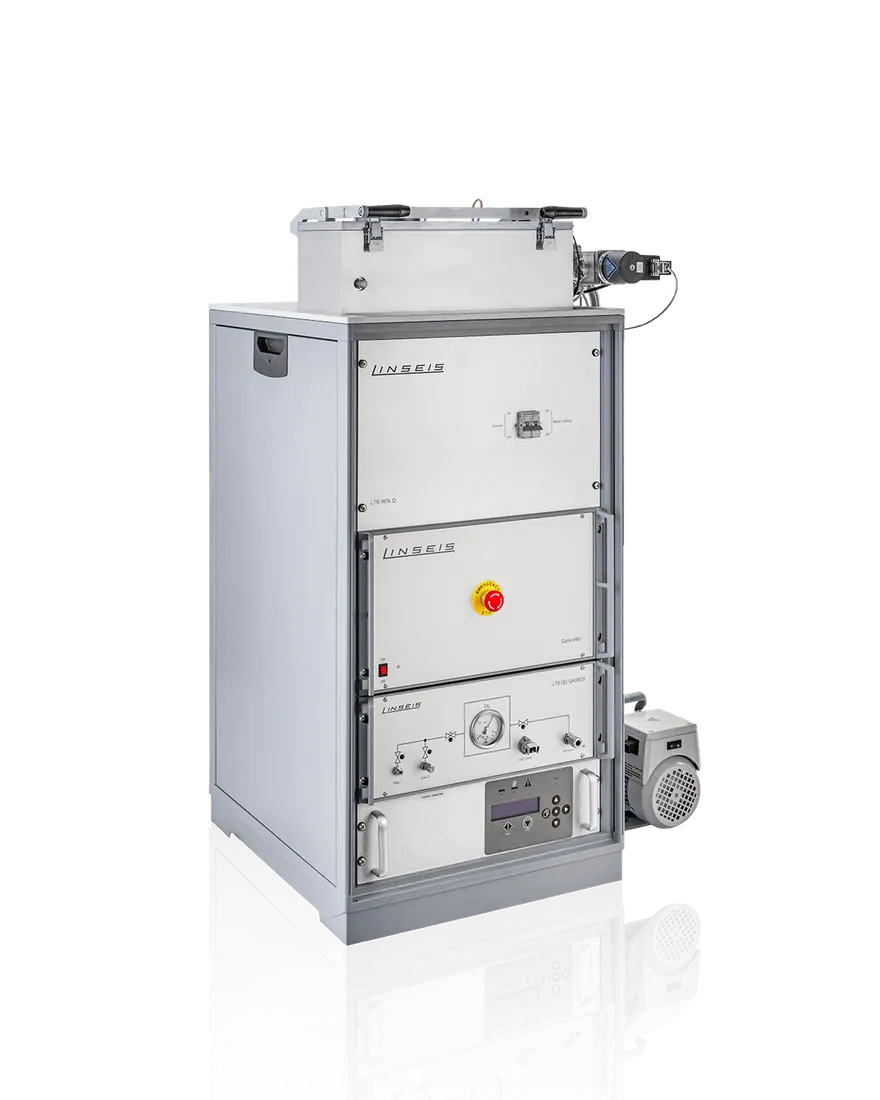
The DIL L78 RITA is a quenching and forming dilatometer that records length change during rapid heating, quenching and deformation. The supplied software produces TTT, CCT and CHT transformation diagrams. It is used for heat treatment development on steels and other metals, including gas quenching.
Technical Specifications
| Parameter | Value |
|---|---|
| Length change resolution | 5 nm (optional 1 nm) |
| Length change measurement range | +/- 1.2 mm (quenching mode), +/- 5 mm (deformation mode) |
| Maximum cooling rates | up to 4000 C/s (hollow samples) |
| Data acquisition rate | up to 1 kHz (synchronised temperature, length and force) |
| Maximum compression force | 22 kN, compression speed 0.005 to 100 mm/s |
| Low temperature operation | down to -150 C (optional) |
Get a Quote
Request an itemised quotation covering the proposed configuration, availability, lead time and agreed supply and support scope.
Useful details to share
- Materials, sample dimensions and process or measurement goal
- Required performance and existing instrument interfaces
Share what you know. You can start with your name and a phone number or email; final specifications can follow.
Not sure which configuration you need? Help me choose
Contact Vvon Technologies Limited about Linseis equipment requirements in Bangladesh.
Phone: +8801805987890 | Email: info@vvon.com.bd
More from Thermal Analysis & Thermophysical Measurement
- DIL HP L70
The DIL HP L70, formerly sold as the DIL L75 HP, is a high pressure dilatometer. It measures the change in length of a sample under combined pressure and temperature, at up to 150 bar and 1100 C. An optional steam generator and gas control extend it to reactive atmosphere testing.
- DIL L76 Horizontal
The DIL L76 Horizontal is an entry level horizontal dilatometer for thermal expansion measurements. It records the change in length of a sample from room temperature to 1600 C using LVDT or optical encoder detection. It suits CTE testing of ceramics, bricks, tiles, porcelain and building materials.
- TMA L71
The TMA L71, formerly sold as the TMA PT 1000, is a thermomechanical analyser. It measures the expansion or deformation of a sample under a defined load as the temperature changes, including three-point bending. It is used to study softening, penetration and dimensional stability.