EDS IR Filter
Brand: Oxford Instruments | Category: Nanotechnology
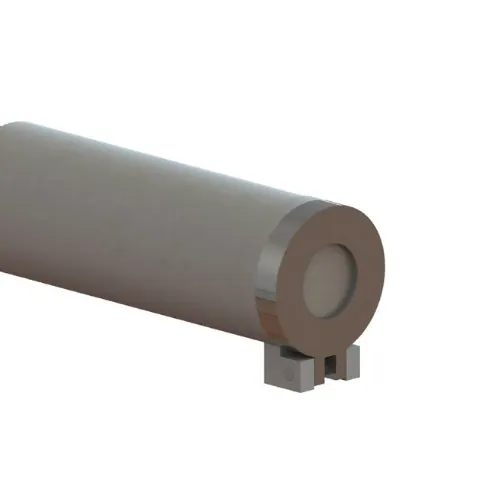
The EDS IR Filter allows energy dispersive X-ray analysis during in situ heating in the SEM. It uses a light material to block infrared radiation from the hot sample while still passing low energy X-rays, and is fitted only for heating work so room temperature analysis is unaffected.
Technical Specifications
| Parameter | Value |
|---|---|
| Specification | Enables in situ heating experiments at up to 1200 °C |
| Specification | Passes low energy X-rays so carbon and boron are still detected |
| Specification | Used only during heating experiments, room temperature EDS is not affected |
Get a Quote
Request an itemised quotation covering the proposed configuration, availability, lead time and agreed supply and support scope.
Useful details to share
- Materials, sample dimensions and process or measurement goal
- Required performance and existing instrument interfaces
Share what you know. You can start with your name and a phone number or email; final specifications can follow.
Not sure which configuration you need? Help me choose
Contact Vvon Technologies Limited about Oxford Instruments equipment requirements in Bangladesh.
Phone: +8801805987890 | Email: info@vvon.com.bd
More from Accessories & Modules
- CMOS NA-TKD Screen
The Near Axis Transmission Kikuchi Diffraction screen is an angled screen positioned close to the axis of the transmitted beam. Used with the Oxford Instruments CMOS EBSD detectors it raises sensitivity, allowing lower probe current and better spatial resolution.
- CMOS EBSD IR Screen
The CMOS EBSD IR Screen lets electron backscatter diffraction run during in situ heating experiments. It blocks the infrared radiation emitted by a hot sample that would otherwise saturate the detector, without the loss of sensitivity caused by coating the phosphor screen.
- Centrus CCD detector
The thermoelectrically cooled CCD detector fitted to Renishaw Raman instruments. It has high quantum efficiency from the deep ultraviolet to the near infrared and ultra-low readout noise, so weak Raman and photoluminescence bands can be detected quickly.