FME23: Basic Pipe Network Unit
Brand: EDIBON | Category: Scientific & Laboratory Equipment
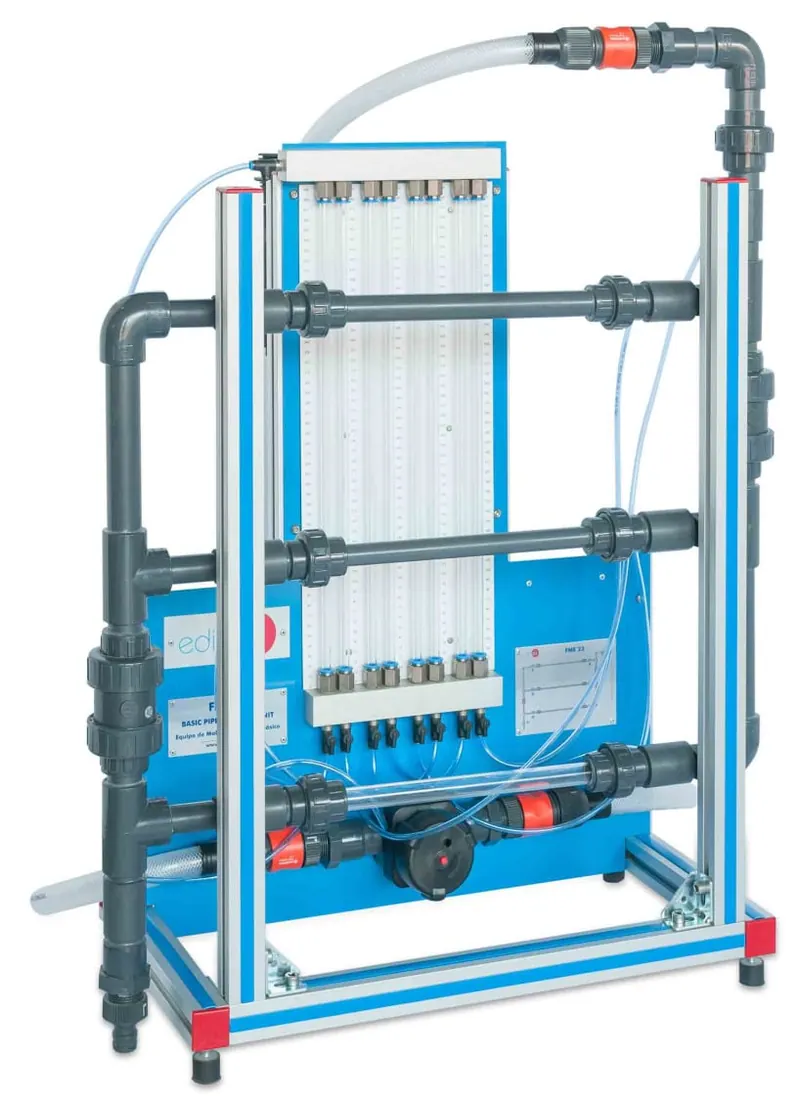
FME23 is a small pipe network with parallel and series branches. Flow and head loss are measured in each branch so students can apply the continuity and energy equations and study how flow divides between alternative paths.
Technical Specifications
| Parameter | Value |
|---|---|
| Manometric tubes | 8 |
| Manometer range | 0–470 mm of water |
| Test pipes | Three PVC pipes of different diameters and one methacrylate pipe |
| Unit dimensions | 600 x 350 x 800 mm approx. |
| Unit weight | 30 kg approx. |
Selected data from the model-specific panel on page 28 of the manufacturer LIFLUBA brochure. Unit dimensions and weights are approximate. The hydraulic bench/feed system and other required elements may be supplied separately; confirm the current model, accessories and complete quotation scope. Checked 2026-09-29.
Manufacturer reference document (opens in a new tab)
Confirm your configuration
Share the details you know so we can prepare a comparable, itemised offer.
- Fluid mechanics experiments, syllabus and number of student workstations
- Required base unit, modules, sensors, control/data-acquisition software and accessories
- Bench/floor space, utilities, practical manuals and faculty training
Get a Quote
Request an itemised quotation covering the proposed configuration, availability, lead time and agreed supply and support scope.
Useful details to share
- Intended application, process or teaching activity
- Required capability and equipment it must work with
Share what you know. You can start with your name and a phone number or email; final specifications can follow.
Not sure which configuration you need? Help me choose
Contact Vvon Technologies Limited about EDIBON equipment requirements in Bangladesh.
Phone: +8801805987890 | Email: info@vvon.com.bd
Back to Scientific & Laboratory Equipment
More from Fluid Mechanics Lab
- FME24: Unit for the Study of Porous Beds in Venturi Tubes (Darcy's Equation)
FME24 is used to study flow through porous media. Water passes through a packed bed in a venturi arrangement while head loss and flow rate are measured, allowing the Darcy equation and the permeability of the bed to be examined.
- FME15: Water Hammer
FME15 is used to demonstrate the pressure surge that follows sudden valve closure. A fast acting valve is shut while pressure is recorded upstream, showing the size of the surge and the speed of the pressure wave in the pipe.
- FMDU: Flow Meters Demonstration
FMDU is a standalone bench comparing the main flow measurement devices. Venturi, orifice plate, nozzle and rotameter are mounted in series with pressure tappings, so discharge coefficients and permanent head loss can be compared.