FME30: Transparent Vortex Flow Meter
Brand: EDIBON | Category: Scientific & Laboratory Equipment
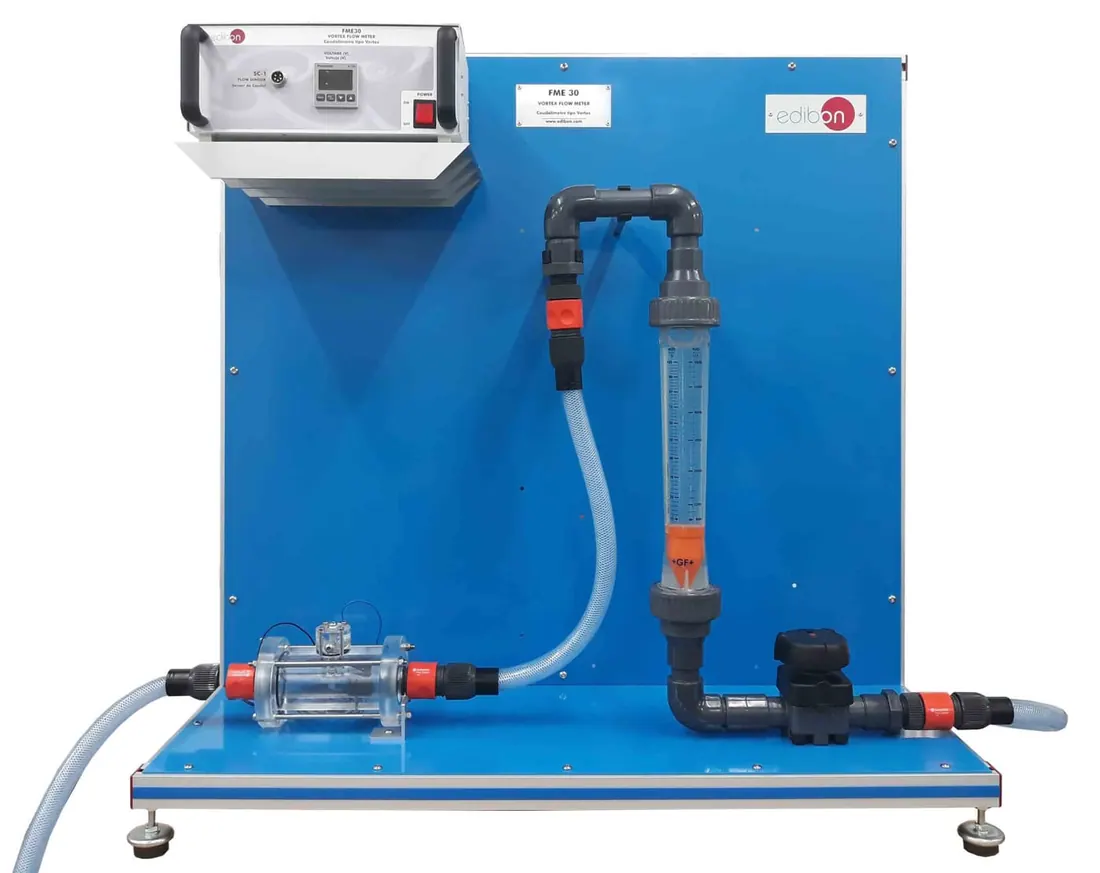
FME30 is a transparent vortex shedding flow meter for teaching. The vortices formed behind a bluff body can be seen and counted, showing how shedding frequency varies with flow rate. An industrial pattern version, FME30/I, is also published.
Technical Specifications
| Parameter | Value |
|---|---|
| Rotameter range | 150–1600 l/h |
| Balance range | 0–2000 g |
| Balance precision | 1 g |
| Graduated vessel capacity | 2 l |
| Unit dimensions | 900 x 570 x 900 mm approx. |
| Unit weight | 30 kg approx. |
Selected data from the model-specific panel on page 8 of the manufacturer LIFLUBA brochure. Unit dimensions and weights are approximate. The hydraulic bench/feed system and other required elements may be supplied separately; confirm the current model, accessories and complete quotation scope. Checked 2026-09-29.
Manufacturer reference document (opens in a new tab)
Confirm your configuration
Share the details you know so we can prepare a comparable, itemised offer.
- Fluid mechanics experiments, syllabus and number of student workstations
- Required base unit, modules, sensors, control/data-acquisition software and accessories
- Bench/floor space, utilities, practical manuals and faculty training
Get a Quote
Request an itemised quotation covering the proposed configuration, availability, lead time and agreed supply and support scope.
Useful details to share
- Intended application, process or teaching activity
- Required capability and equipment it must work with
Share what you know. You can start with your name and a phone number or email; final specifications can follow.
Not sure which configuration you need? Help me choose
Contact Vvon Technologies Limited about EDIBON equipment requirements in Bangladesh.
Phone: +8801805987890 | Email: info@vvon.com.bd
Back to Scientific & Laboratory Equipment
More from Fluid Mechanics Lab
- FME32: Static Pitot Tube
FME32 is a Pitot static tube module for measuring local velocity in a pipe. Total and static pressure tappings are connected to a manometer so the velocity head can be read and a velocity profile built up across the section.
- FME26: Depression Measurement System (vacuum gauge)
FME26 is a vacuum gauge module for measuring depression in fluid circuits. It is used with the hydraulics bench to read the negative pressure at pump suction and at points of flow contraction such as venturi throats.
- FME34: Fluid Statics and Manometry
FME34 is a module for teaching pressure measurement with liquid columns. U tube, inclined and well type manometers are connected to a pressurised vessel so students can compare readings and study the effect of tube inclination on sensitivity.