LSR L31
Brand: Linseis | Category: Nanotechnology
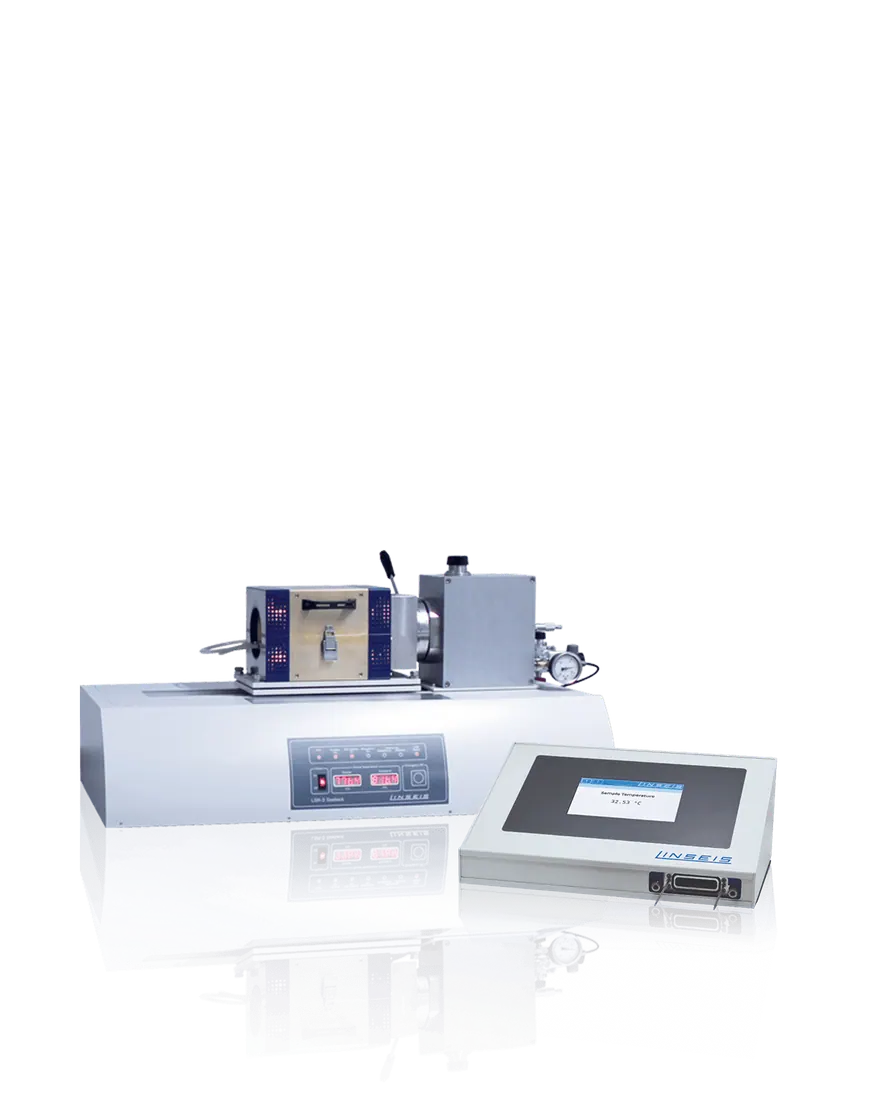
The LSR L31, formerly the LSR-1, characterises thermoelectric materials as bulk samples and thin films. It measures the Seebeck coefficient and the specific electrical resistance, with a cryo option down to -160 C. The sample sits on an integrated PCB board with two heaters.
Technical Specifications
| Parameter | Value |
|---|---|
| Temperature range | basic unit RT to 200 C, cryo option -160 C to +200 C |
| Seebeck coefficient measuring range | 0 to 2.5 mV/K, temperature gradient up to 10 K |
| Seebeck voltage measurement | range +/-8 mV |
| Sample size (Seebeck) | L 8 mm to 25 mm, W 2 mm to 25 mm, D thin film up to 2 mm |
| Heating rate | 0.01 to 100 K/min |
| Atmospheres | inert, reducing, oxidising, vacuum |
Get a Quote
Request an itemised quotation covering the proposed configuration, availability, lead time and agreed supply and support scope.
Useful details to share
- Materials, sample dimensions and process or measurement goal
- Required performance and existing instrument interfaces
Share what you know. You can start with your name and a phone number or email; final specifications can follow.
Not sure which configuration you need? Help me choose
Contact Vvon Technologies Limited about Linseis equipment requirements in Bangladesh.
Phone: +8801805987890 | Email: info@vvon.com.bd
More from Thermal Analysis & Thermophysical Measurement
- HCS L36
The HCS L36 is a Hall effect measuring system. It determines charge carrier mobility, specific resistance, charge carrier concentration and the Hall constant of a sample. Plug-and-play sample holders take pieces up to 12.5 x 12.5 mm2 for electrical characterisation of semiconductors.
- LSR L33
The LSR L33, formerly the LSR-3, measures the Seebeck coefficient and the electrical conductivity of solids and thin films. The sample is clamped vertically between two electrodes and interchangeable furnaces cover -100 C to 1500 C. It is used to characterise thermoelectric materials.
- TFA L59
The TFA L59 is a thin film analyser for layers in the nanometre to micrometre range. Using pre-structured measuring chips it determines thermal conductivity by the 3 Omega method along with heat capacity, and optionally electrical conductivity and Hall data. It works from -160 C to 280 C.