MultiHarp 150
Brand: PicoQuant | Category: Nanotechnology
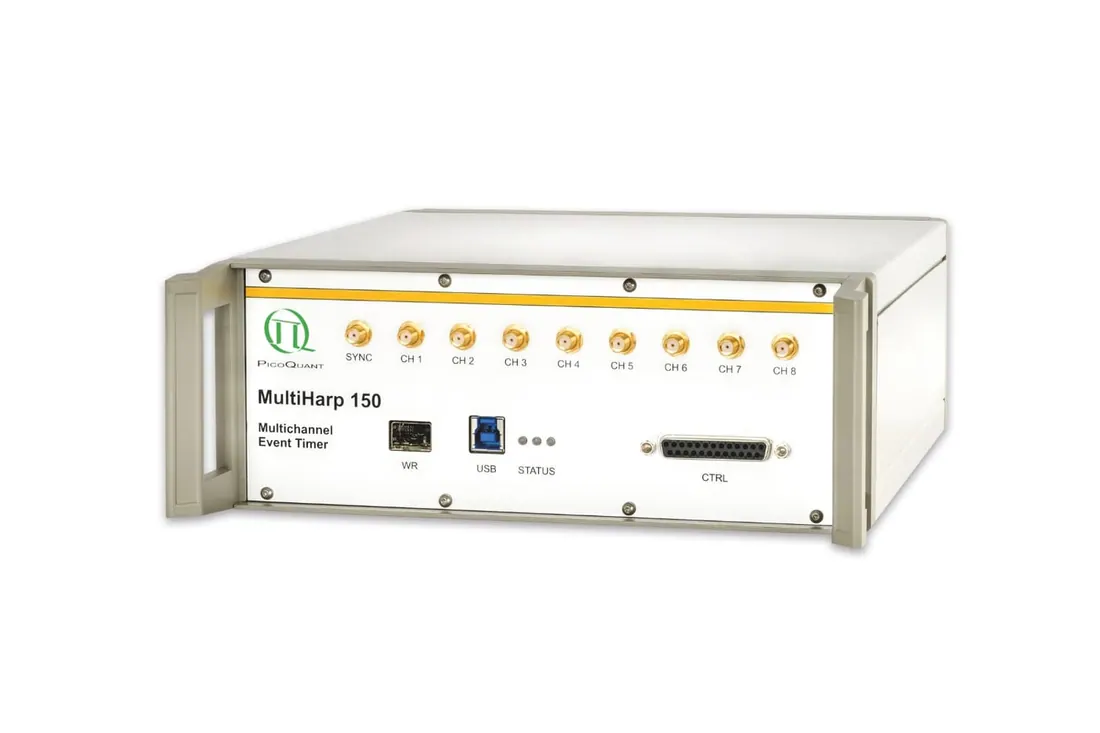
The MultiHarp 150 is a multichannel time tagging and TCSPC unit for high-throughput photon counting. The P version provides 4, 8 or 16 detector channels at a 5 ps minimum time bin width, while the N version provides 4 or 8 channels at 80 ps. Both keep dead time below 650 ps.
Technical Specifications
| Parameter | Value |
|---|---|
| Number of detector channels (in addition to sync) | 4, 8 or 16 (MultiHarp 150 P) | 4 or 8 (MultiHarp 150 N) |
| Minimum time bin width | 5 ps (150 P), 80 ps (150 N) |
| Timing precision | < 28 ps RMS (150 P), < 85 ps RMS (150 N) |
| Dead time | < 650 ps (can be increased via software up to 160 ns in steps of 1 ns) |
| Peak count rate per input channel | 1.5 Gcps for burst durations up to 1.3 µs |
| Sustained count rate per input channel | 78 Mcps, total 85 Mcps summed over all input channels |
Get a Quote
Request an itemised quotation covering the proposed configuration, availability, lead time and agreed supply and support scope.
Useful details to share
- Materials, sample dimensions and process or measurement goal
- Required performance and existing instrument interfaces
Share what you know. You can start with your name and a phone number or email; final specifications can follow.
Not sure which configuration you need? Help me choose
Contact Vvon Technologies Limited about PicoQuant equipment requirements in Bangladesh.
Phone: +8801805987890 | Email: info@vvon.com.bd
More from Photoluminescence & Time-Resolved Spectroscopy
- TimeHarp 260
The TimeHarp 260 is a TCSPC and MCS board in PCIe format, available with one or two detector channels. The PICO version reaches a 25 ps minimum time bin width and the NANO version 250 ps, with sustained throughput of 40 Mcps summed over all channels. It performs photon counting inside a host PC.
- MultiHarp 160
The MultiHarp 160 is a high-throughput multichannel time tagging and TCSPC unit. It records photon arrival times on 16 channels in the main unit, extendable to 64 channels with extension units, at a 5 ps minimum time bin width. It is used for quantum communication research and detector testing.
- PMA Series
The PMA Series are integrated photomultiplier detector assemblies for time-correlated single photon counting. The PMA 175 covers 230 to 700 nm and the PMA 192 covers 230 to 920 nm, both with transit time spread below 180 ps. Cooled versions lower the dark count rate for work on weak signals.