PPG 512
Brand: PicoQuant | Category: Nanotechnology
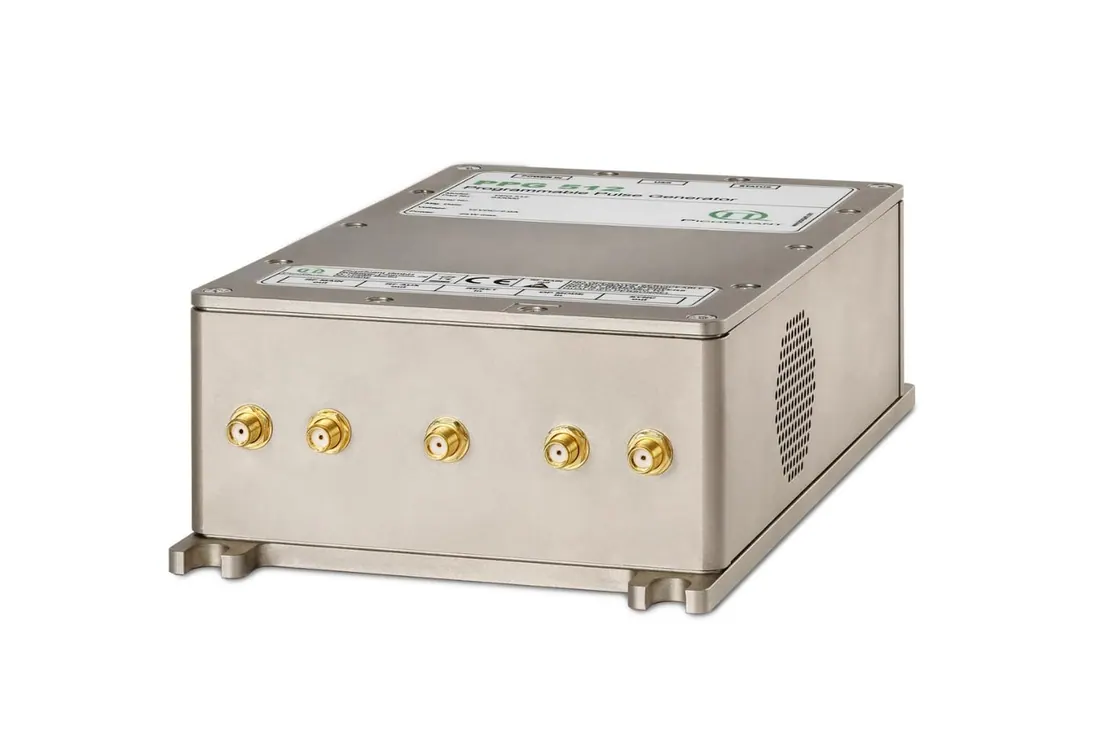
The PPG 512 is a programmable pulse generator for nanosecond pulse shaping of lasers and amplifiers. A 512 byte pattern is read out at 5 GS/s in 200 ps time bins, and the main output is adjustable between 0V and + 12 V into 50 Ohms in 256 steps. A sync pulse follows every 512 bytes, that is every 102.4 ns.
Technical Specifications
| Parameter | Value |
|---|---|
| Pulse pattern length | 512 bytes |
| Readout speed | 5 GS/s, 200 ps time bins, other sampling rates <5 GS/s on request |
| Max. pulse width | no limitation, DC-Level are also possible |
| Main output (into 50 Ohm) | adjustable between 0V and + 12 V in 256 steps (8 bit), other values on request |
| Aux output | attenuated main output |
| Sync out | + 0.5 V after reading all 512 bytes, i.e. every 102.4 ns |
Get a Quote
Request an itemised quotation covering the proposed configuration, availability, lead time and agreed supply and support scope.
Useful details to share
- Materials, sample dimensions and process or measurement goal
- Required performance and existing instrument interfaces
Share what you know. You can start with your name and a phone number or email; final specifications can follow.
Not sure which configuration you need? Help me choose
Contact Vvon Technologies Limited about PicoQuant equipment requirements in Bangladesh.
Phone: +8801805987890 | Email: info@vvon.com.bd
More from Photoluminescence & Time-Resolved Spectroscopy
- FLS1000: Photoluminescence Spectrometer
Modular research spectrometer for steady state and time-resolved photoluminescence, built around Czerny-Turner monochromators with plug and play triple grating turrets. Sources, detectors and sample chambers are interchangeable, so one instrument covers spectral, fluorescence lifetime and phosphorescence lifetime work. Double monochromators are available where stray light rejection matters.
- PPL 512 / PPA 512
The PPL 512 and PPA 512 are a programmable pulse laser and amplifier for nanosecond pulse shaping. A 512 byte pattern is read out at 5 GS / s in 200 ps time bins, so the emitted waveform can be defined step by step. A synchronisation output and USB control are provided for integration into larger setups.
- FS5: Spectrofluorometer
Compact benchtop spectrofluorometer measuring both absorption and fluorescence in one instrument, with photon counting detection as standard. Sample modules are auto-recognised and swap in seconds, so the instrument moves between cuvettes, solids and plate formats without realignment. It upgrades to near infrared detection, time-resolved measurement, quantum yield and anisotropy.