Saphir 560 / Rubin 520: Grinding and Polishing Machine
Brand: QATM | Category: Scientific & Laboratory Equipment
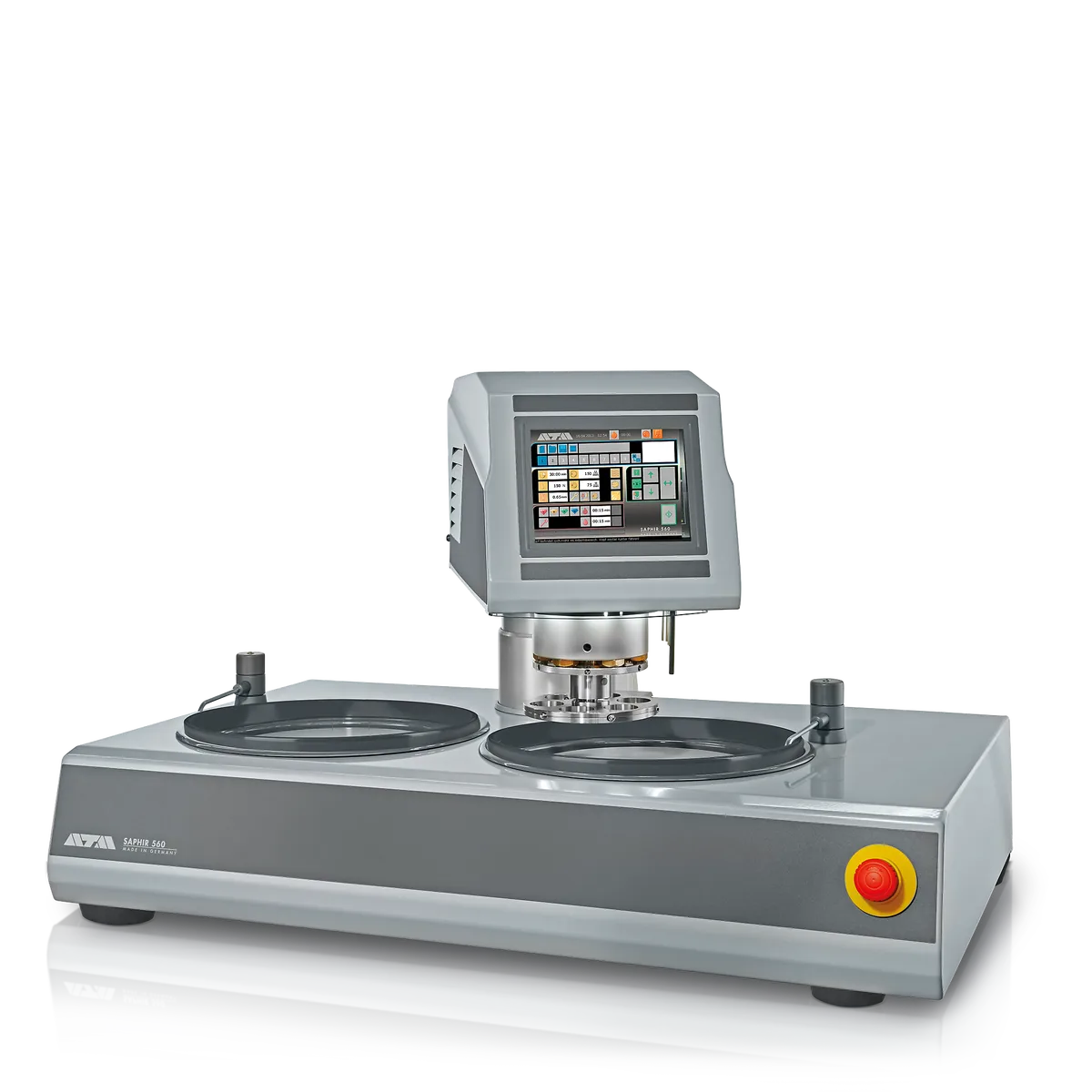
Grinding and polishing machine combining a Saphir 560 base unit with a Rubin 520 preparation head, the larger base in the Saphir line. As with the 550 combination, the head applies specimen load and the base drives the working wheel under programmed control.
Selected manufacturer specifications
| Parameter | Value |
|---|---|
| No. of samples (single pressure) | 1-6 samples Ø 50 mm |
| Single pressing force | 5-80 N |
| Connection power | 5.5 kVA |
| Drive power (base) | 2x 0.75 kW S6/40% |
| Drive power (head) | 0.17 kW S1 |
| Speed (grinder) | 50 - 600 rpm |
| Speed (head) | 30 -150 rpm |
| W x H x D | 1020 x 550 - 650 x 660 mm |
| Weight | ~ 110 kg |
Selected values from the manufacturer’s technical data for this product or explicitly named model variants. Measurement performance depends on the sample and configuration. Confirm the current model, utilities, accessories and acceptance criteria in the quotation. Checked 2026-09-29.
Confirm your configuration
Share the details you know so we can prepare a comparable, itemised offer.
- Sample material, dimensions/quantity and required preparation or analysis result
- Measuring/working range, repeatability requirements and compatible accessories
- Utilities, calibration/reference materials, software and service scope
Get a Quote
Request an itemised quotation covering the proposed configuration, availability, lead time and agreed supply and support scope.
Useful details to share
- Intended application, process or teaching activity
- Required capability and equipment it must work with
Share what you know. You can start with your name and a phone number or email; final specifications can follow.
Not sure which configuration you need? Help me choose
Contact Vvon Technologies Limited about QATM equipment requirements in Bangladesh.
Phone: +8801805987890 | Email: info@vvon.com.bd
Back to Scientific & Laboratory Equipment
More from Materials Testing Lab
- Qpol XL: Grinding and Polishing Machine
Large format grinding and polishing machine taking 300 mm and 350 mm working wheels and sample holders from 159 mm to 204 mm diameter. Both wheel and holder speeds are variable, which allows the removal rate and surface finish to be set independently.
- Saphir 550 / Rubin 520: Grinding and Polishing Machine
Grinding and polishing machine pairing a Saphir 550 base unit with a Rubin 520 preparation head. The head carries the sample holder and applies the load while the base drives the working wheel, so head and base can be specified to suit the throughput a laboratory needs.
- Qpol Vibro: Vibratory Polisher
Vibratory polisher that produces specimen surfaces with almost no residual deformation, by letting the sample move under its own weight on a vibrating cloth rather than being pressed against it. That matters for electron backscatter diffraction, atomic force microscopy and nanoindentation, where a deformed layer would mask the result.