TFTC: Computer Controlled Nozzle Performance Test Unit
Brand: EDIBON | Category: Scientific & Laboratory Equipment
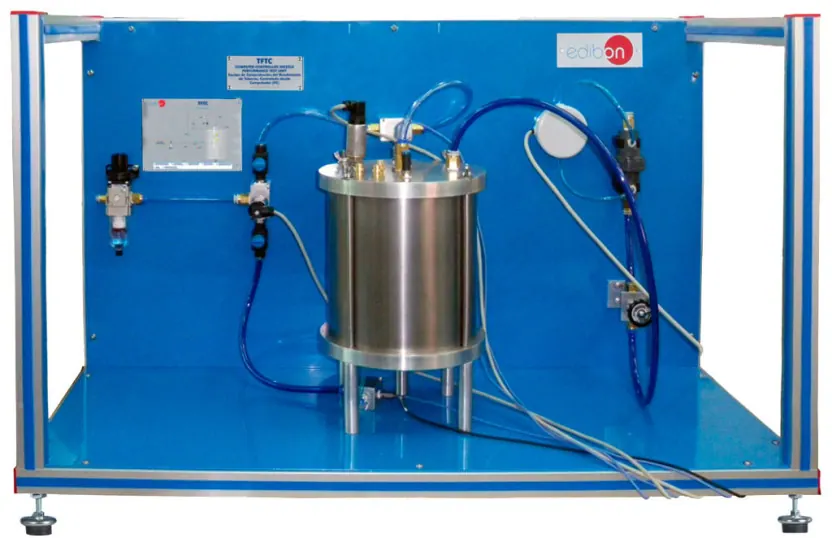
Pressure chamber unit for investigating nozzle kinetic energy and thrust from a laboratory compressed air supply. Students demonstrate choking, measure jet reaction and specific thrust, and compare the actual mass flow rate with the theoretical value.
Technical Specifications
| Parameter | Value |
|---|---|
| Specification | Supplied with one convergent and four convergent divergent nozzles, rapidly interchangeable |
| Specification | Pressure chamber with two nozzle supports and a force sensor in the bottom support |
| Specification | Three temperature sensors, two at the chamber inlets and one in the chamber |
| Specification | Chamber pressure held by a pressure control system |
| Specification | Outlet sensor calculates the air flow leaving the chamber |
| Specification | Supplied with EDIBON SCADA computer control, data acquisition and data management software |
Get a Quote
Request an itemised quotation covering the proposed configuration, availability, lead time and agreed supply and support scope.
Useful details to share
- Intended application, process or teaching activity
- Required capability and equipment it must work with
Share what you know. You can start with your name and a phone number or email; final specifications can follow.
Not sure which configuration you need? Help me choose
Contact Vvon Technologies Limited about EDIBON equipment requirements in Bangladesh.
Phone: +8801805987890 | Email: info@vvon.com.bd
Back to Scientific & Laboratory Equipment
More from Thermodynamics Lab
- TPT: Nozzle Pressure Distribution Unit
Unit for investigating pressure distribution and mass flow rate in convergent and convergent divergent nozzles. Compressed air is regulated at the nozzle inlet and outlet, and each pressure tapping has its own manometer so the choking effect can be shown visually.
- TMHA: Air Humidity Measurement Unit
Stainless steel duct fitted with several humidity instruments so that their accuracy can be compared. The duct can be humidified with an ultrasonic atomiser and dehumidified with a Peltier element, and a variable flow fan shows the effect of airflow on each instrument.
- TMSB: Stirling Motor
Alfa type Stirling engine that converts thermal energy into mechanical energy and can drive an electrical generator. The four phases of the ideal Stirling cycle are followed on two power pistons in separate hot and cold cylinders linked through a regenerator.