WinNormos-for-Igor Software Package with WinSite and WinDist
Brand: WissEl | Category: Nanotechnology
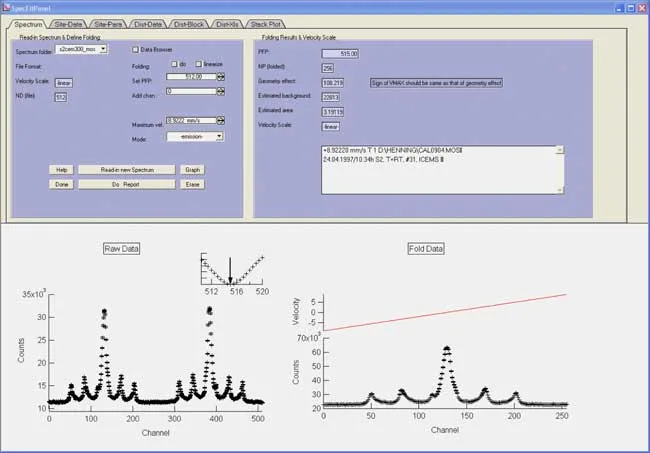
WinNormos-for-Igor tackles almost all the common problems met in Mossbauer spectroscopy, bringing the old DOS Normos Site and Dist routines together in one package that runs inside the Igor graphing and analysis programme from WaveMetrics. All Mossbauer isotopes can be selected at run time, most of them predefined, and the static Hamiltonian is solved exactly for any isotope, with true transmission integral fits and automatic folding for triangular or sinusoidal velocity. WinSite treats a discrete set of subspectra while WinDist handles distributions in hyperfine field, quadrupole splitting or isomer shift, including correlation effects, Gaussian and Voigt distribution profiles and polarised source experiments with spin texture evaluation. Velocity calibration can be taken from WissEl laser drive files, workspaces are stored and recovered as Igor experiments with all numerical results, and reports can be generated automatically in Rich Text Format.
Confirm your configuration
Share the details you know so we can prepare a comparable, itemised offer.
- Installed instrument/controller and software version to be supported
- Required analysis modules, licence term, number of users and data export
- Computer requirements, installation, training and update/support entitlement
Get a Quote
Request an itemised quotation covering the proposed configuration, availability, lead time and agreed supply and support scope.
Useful details to share
- Materials, sample dimensions and process or measurement goal
- Required performance and existing instrument interfaces
Share what you know. You can start with your name and a phone number or email; final specifications can follow.
Not sure which configuration you need? Help me choose
Contact Vvon Technologies Limited about WissEl equipment requirements in Bangladesh.
Phone: +8801805987890 | Email: info@vvon.com.bd
More from Instrument Software
- WiRE Correlate module
Correlate lets Raman results be compared against images from many other microscopy systems, among them scanning electron microscopy (SEM), fluorescence, atomic force microscopy (AFM), infra-red and optical microscopes. You record the coordinates of three or more reference points and data acquisition points on the sample, and the module then guides you back to the same regions of interest once the sample has been transferred between microscopes. A Coordinate Manager imports and transforms coordinates from commonly used microscopy systems, while an Image Alignment Tool gives translation, rotation, sizing and aspect ratio control for overlay at variable transparency. Batch measurements automate the same Raman measurement at different positions on a sample.
- PTIQ
PTIQ is the next generation control software for Oxford Instruments plasma systems, built for the PlasmaPro, Atomfab and Ionfab platforms in both research laboratories and volume production. It logs process data at millisecond accuracy with 1,000-point logging, offers visual proactive readiness indicators, and provides calibration, fault finding and device fingerprinting tools alongside fully programmable multi-cassette load and unload scheduling. The interface is SEMI E95 compliant, touchscreen compatible for cleanroom and yellow-light areas, and supports multi-user profiles for operators, engineers and maintenance teams. Optional modules extend it further, including DiagnostIQs for advanced diagnostics, calibration and predictive maintenance, and a Web API with CSV recipe run data export.
- WiRE Cosmic Ray Removal tool
Cosmic rays are high energy particles from outer space, and over a long measurement they leave spurious spikes in Raman spectra. Renishaw's Cosmic Ray Remover (CRR) tool in WiRE software deals with them either as the data is collected or afterwards. Acquiring three accumulations and taking the median value at each frequency eliminates spikes during collection, while a simple zap function or the automated CRR processing tool handles files that already contain many features. Removing the spikes preserves spectral band shape, leaves images free of artefacts and gives more confidence when unsupervised chemometric methods such as PCA are applied.