400 Series Hall Probes
Brand: Lake Shore | Category: Nanotechnology
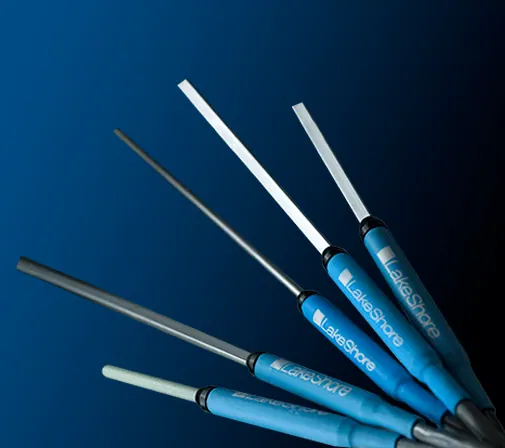
Lake Shore 400 Series Hall probes hold a Hall sensing element in a protective stem so magnetic flux density can be measured with a gaussmeter. Several probe configurations and Hall sensor types are offered. They are used for field mapping, magnet inspection and routine field checks.
Selected manufacturer specifications
| Parameter | Value |
|---|---|
| Standard cable length | 2 m, except Model 410 and cryogenic probes |
| Alternative cable lengths | 6, 10 or 30 m |
400-series probes use different sensors, geometries and calibrations. Confirm the selected probe and meter; cable options do not establish a common field range or accuracy. Checked 2026-09-29.
Confirm your configuration
Share the details you know so we can prepare a comparable, itemised offer.
- Material/sample geometry and required measurement range or uncertainty
- Compatible sensors, fixtures, controller and environmental conditions
- Reference materials, calibration, software and installation scope
Get a Quote
Request an itemised quotation covering the proposed configuration, availability, lead time and agreed supply and support scope.
Useful details to share
- Materials, sample dimensions and process or measurement goal
- Required performance and existing instrument interfaces
Share what you know. You can start with your name and a phone number or email; final specifications can follow.
Not sure which configuration you need? Help me choose
Contact Vvon Technologies Limited about Lake Shore equipment requirements in Bangladesh.
Phone: +8801805987890 | Email: info@vvon.com.bd
More from Electrical & Electrochemical Characterisation
- FP Series Hall Probes
FP Series Hall probes measure magnetic flux density in 3-axis (vector), transverse and axial forms. Each probe uses an InAs sensing element with a built-in thermistor for temperature compensation. Stem lengths of 50 mm, 150 mm and 300 mm are available with handheld or mountable handles.
- InAs and GaAs Hall Sensors
InAs and GaAs Hall sensors are supplied as bare sensing elements in axial and transverse packages for measuring magnetic flux density. Types range from general purpose parts to instrumentation quality sensors with low temperature coefficients. They are used with Lake Shore 400 Series gaussmeters.
- Guarded Insert for PPMS
This insert carries van der Pauw and Hall bar samples inside a PPMS cryostat, with a fully guarded signal path from instrument to sample. Used with the M91 FastHall controller it measures resistance from 10 milliohms to 200 gigaohms between 1.9 K and 400 K. An integrated Cernox sensor reads sample temperature.