Cryogen-Free Cryogenic Cold Trap Cryostats
Brand: Lake Shore | Category: Nanotechnology
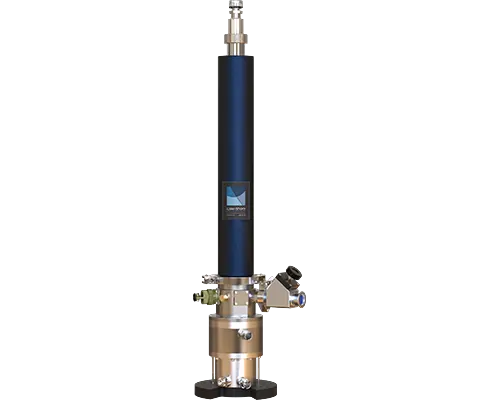
These cold traps use a mechanical closed-cycle cooler to adsorb noble gases, including helium, neon, argon, krypton and xenon. The cold surface is held below 9 K so gas is captured from a vacuum line without liquid cryogens. Three models cover different upper temperature limits.
Technical Specifications
| Parameter | Value |
|---|---|
| Models | CCS-TRAP, CCS-TRAP-S, CCS-TRAP-CORE |
| Temperature range | <8 K to 450 K (CCS-TRAP), <8 K to 500 K (CCS-TRAP-S), <9 K to 300 K (CCS-TRAP-CORE) |
| Typical temperature stability | +/-50 mK |
| Sample environment | Exchange gas |
| Cooldown | 1 h to 1.5 h |
| Weight, not including flexlines or compressor (approximate) | 19.1 kg (42 lb) |
Get a Quote
Request an itemised quotation covering the proposed configuration, availability, lead time and agreed supply and support scope.
Useful details to share
- Materials, sample dimensions and process or measurement goal
- Required performance and existing instrument interfaces
Share what you know. You can start with your name and a phone number or email; final specifications can follow.
Not sure which configuration you need? Help me choose
Contact Vvon Technologies Limited about Lake Shore equipment requirements in Bangladesh.
Phone: +8801805987890 | Email: info@vvon.com.bd
More from Cryogenics & Temperature Control
- Cryogen-Free Exchange Gas Cryostats
These cryostats cool the sample in exchange gas using a closed-cycle refrigerator, so no liquid cryogen is needed. Samples may be solid, liquid or powder, conductive or non-conductive, and are changed in under 10 minutes. A wide choice of feedthrough and window options is offered.
- 240 Series Input Modules
The 240 Series Input Modules read cryogenic temperature sensors and pass the measurement onto a distributed control network. They are intended for large scale installations that use PLC based control rather than a single benchtop instrument. They suit systems with many sensor points spread across a facility.
- Cryogen-Free Continuous Low Temp Cryostats
The SHI-950-LT cryostats use a closed-cycle refrigerator to cool samples in exchange gas to 1.5 K without liquid cryogens. An optional helium-3 insert takes the base temperature to 300 mK, and the upper limit is 800 K. Optical and non-optical versions are available.