Epoxy
Brand: Lake Shore | Category: Nanotechnology
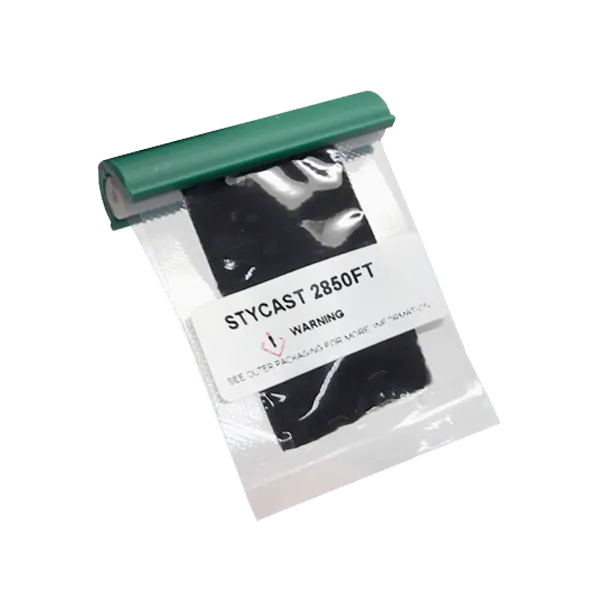
Lake Shore supplies resin and conducting epoxies for installing and fastening sensors, providing thermal contact and electrical insulation. The conductive epoxy is rated to 573 K and the Stycast resin epoxy to 403 K. Stycast gives a dielectric strength of 14.4 kV/mm.
Technical Specifications
| Parameter | Value |
|---|---|
| Types | low-temperature conductive epoxy and Stycast epoxy |
| Maximum temperature | 573 K (conductive), 403 K (Stycast) |
| Thermal conductivity at 300 K | 2.5 W/(m·K) conductive, 1.3 W/(m·K) Stycast |
| Volume resistivity | 0.0001 to 0.0004 Ω·cm at 298 K (conductive), 5 x 10^14 Ω·m at 298 K (Stycast) |
| Pot life | 4 days with about 1 day working time (conductive), 45 min with about 20 min working time (Stycast) |
| Shelf life (298 K max) | 12 months from date of manufacture at room temperature |
Get a Quote
Request an itemised quotation covering the proposed configuration, availability, lead time and agreed supply and support scope.
Useful details to share
- Materials, sample dimensions and process or measurement goal
- Required performance and existing instrument interfaces
Share what you know. You can start with your name and a phone number or email; final specifications can follow.
Not sure which configuration you need? Help me choose
Contact Vvon Technologies Limited about Lake Shore equipment requirements in Bangladesh.
Phone: +8801805987890 | Email: info@vvon.com.bd
More from Accessories & Modules
- Grease
Lake Shore offers low-temperature and high-temperature grease for installing and fastening sensors where a removable joint is wanted. Apiezon type N melts at about 303 K and suits cryogenic work, while type H is rated to about 513 K. Both have very low vapour pressure for vacuum use.
- Cryogenic Cable
Lake Shore cryogenic coaxial cable carries high-frequency signals into a cryostat with low heat leak. Type SC uses a stranded copper centre conductor, Type SS uses 304 stainless steel and Type SR is semi-rigid carbon steel. Characteristic impedance is 35, 40 or 50 ohms by type.
- Solder
Lake Shore supplies solder for mounting sensors, making electrical connections and heat sinking wire in cryogenic assemblies. Indium foil melts at 430 K and has the highest thermal conductivity of the three at 84 W/(m·K), while Ostalloy melts at 343.16 K for low-temperature joints.