Germanium
Brand: Lake Shore | Category: Nanotechnology
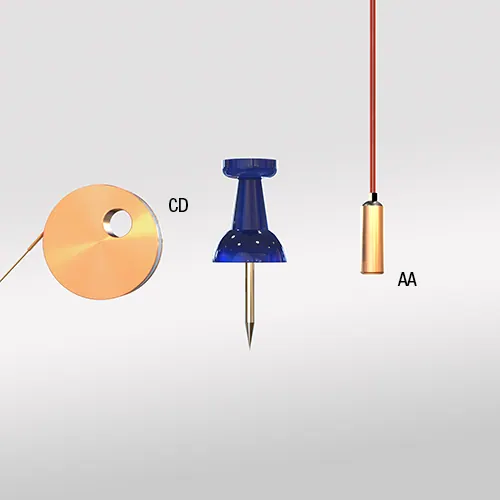
Germanium resistance temperature sensors are used for demanding low temperature measurement, where stability and reproducibility matter most. Three models cover from below 0.05 K to 100 K, with short-term reproducibility of +/-0.5 mK at 4.2 K and long-term drift of +/-1 mK per year.
Technical Specifications
| Parameter | Value |
|---|---|
| Models | GR-50-AA, GR-300-AA, GR-1400-AA |
| Temperature range | <0.05 K to 5 K (GR-50-AA), 0.3 K to 100 K (GR-300-AA), 1.4 K to 100 K (GR-1400-AA) |
| Short-term reproducibility | +/-0.5 mK at 4.2 K |
| Long-term stability | +/-1 mK/yr at 4.2 K, +/-10 mK/yr at 77 K |
| Typical sensor accuracy at 4.2 K | +/-6 mK (GR-50), +/-4 mK (GR-300), +/-4 mK (GR-1400) |
| Typical sensor accuracy at 77 K | +/-25 mK (GR-300), +/-15 mK (GR-1400) |
Get a Quote
Request an itemised quotation covering the proposed configuration, availability, lead time and agreed supply and support scope.
Useful details to share
- Materials, sample dimensions and process or measurement goal
- Required performance and existing instrument interfaces
Share what you know. You can start with your name and a phone number or email; final specifications can follow.
Not sure which configuration you need? Help me choose
Contact Vvon Technologies Limited about Lake Shore equipment requirements in Bangladesh.
Phone: +8801805987890 | Email: info@vvon.com.bd
More from Cryogenics & Temperature Control
- Platinum
Platinum resistance thermometers follow the IEC 751 standard curve and serve as cryogenic temperature sensing and control elements. The PT-103 covers 14 K to 873 K and the PT-111 covers 14 K to 673 K, both at 1 mA recommended excitation. Short-term stability is +/-5 mK at 77 K.
- DT-670 Silicon Diodes
DT-670 silicon diodes are cryogenic temperature sensors that give a voltage output which varies with temperature. They cover 1.4 K to 500 K in the SD, CU-HT and BR packages and 1.4 K to 420 K in the others, with typical accuracy of +/-12 mK at 4.2 K and +/-35 mK at 300 K.
- HR Series Sensors
HR Series cryogenic temperature sensors are tested for durability and precision, which suits mission-critical work. They come in SD and CU packages with a choice of lead options, including Quad-Lead and Quad-Twist wire. Resistance and sensitivity data are published from 20 K to 300 K.