Luminosa PDA-23 Add-On
Brand: PicoQuant | Category: Nanotechnology
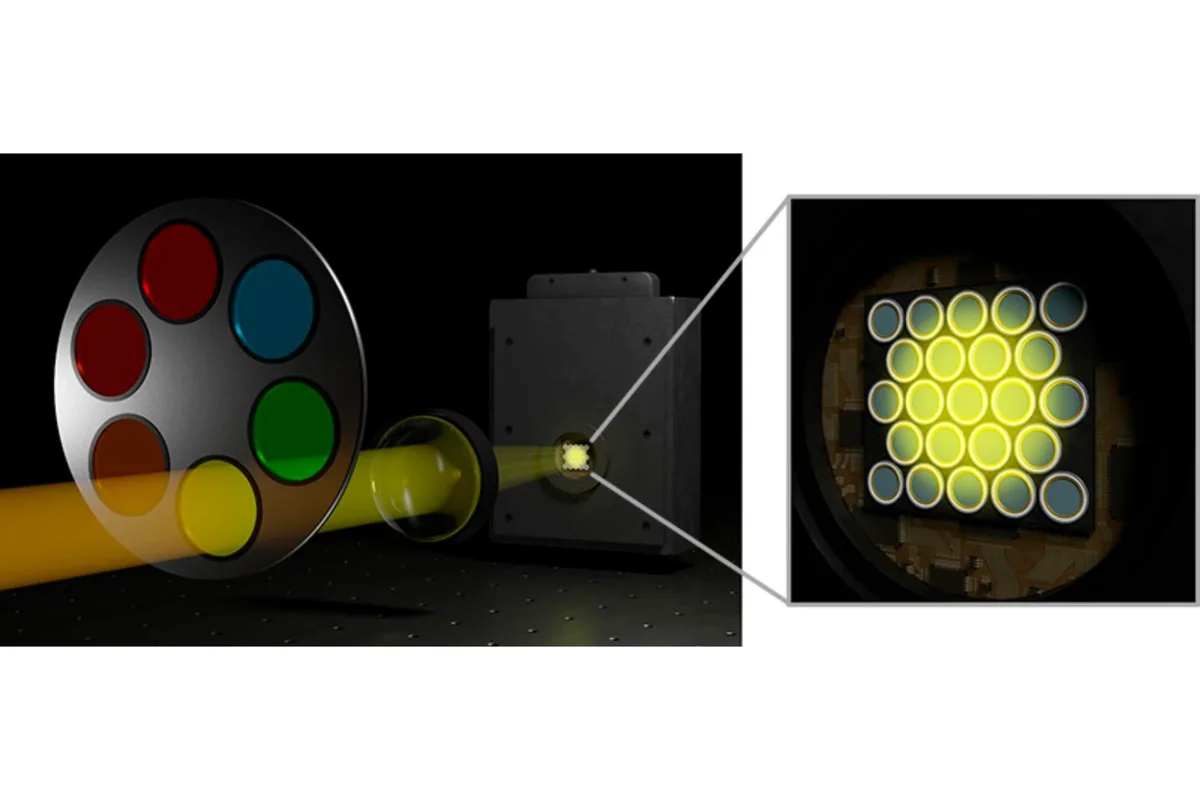
The PDA-23 add-on equips the Luminosa confocal microscope with a cooled 23-pixel SPAD array for confocal time-resolved detection, combining the higher resolution of image scanning microscopy with quantitative FLIM. Pixel reassignment raises resolution by about 30%, taking 485 nm excitation down to 155 nm FWHM, and deconvolution takes that further to 120 nm FWHM. Computational sectioning improves contrast by rejecting out of focus light, and every pixel of the array is time tagged, with dual-channel acquisition available simultaneously through pulsed interleaved excitation. Integrated in Luminosa, the detector keeps alignment stable and pairs with the MultiHarp 160 multichannel time tagging and TCSPC unit, with analysis handled in NovaISM.
Selected manufacturer specifications
| Parameter | Value |
|---|---|
| Detector architecture | 23 independent SPAD pixels |
| Active area | 100 × 110 µm |
| Effective fill factor with microlenses | Greater than 75%; typically 80% |
| Usable spectral window | 400–950 nm |
| Typical peak photon detection efficiency | 55% at 520 nm |
| Timing jitter | Less than 120 ps FWHM at 510–785 nm |
| Listed cooled operating temperature | 10°C |
PDA-23 section of the Luminosa datasheet, January 2026, page 3. Typical detection efficiency is wavelength-dependent; detector jitter must not be confused with TCSPC bin width. Confirm host-system compatibility. Checked 2026-09-29.
Manufacturer reference document (opens in a new tab)
Confirm your configuration
Share the details you know so we can prepare a comparable, itemised offer.
- Sample type, measurement method and required spectral/time range
- Source/laser, detector, resolution, sample holder and optical interfaces
- Software, laser safety/site requirements, calibration and application training
Get a Quote
Request an itemised quotation covering the proposed configuration, availability, lead time and agreed supply and support scope.
Useful details to share
- Materials, sample dimensions and process or measurement goal
- Required performance and existing instrument interfaces
Share what you know. You can start with your name and a phone number or email; final specifications can follow.
Not sure which configuration you need? Help me choose
Contact Vvon Technologies Limited about PicoQuant equipment requirements in Bangladesh.
Phone: +8801805987890 | Email: info@vvon.com.bd
More from Photoluminescence & Time-Resolved Spectroscopy
- MicroTime 200 STED Add-On
This open STED add-on extends the MicroTime 200 to super-resolution imaging with time-resolved contrast, resolving nanoscale structures below 50 nm that confocal images cannot separate. A stable donut shaped depletion beam is produced by an EASYDOnut phase plate, which avoids complex alignment, and gSTED time gating isolates late photons for better resolution and sensitivity. Triple-species STED imaging is possible using fluorescence pattern matching for accurate multicolour co-localisation, and the reduced observation volume benefits STED-FCS by allowing diffusion measurements at higher concentrations. Full compatibility with the MicroTime 200 is retained, and the complete STED workflow including time gating and multi-species pattern matching runs in SymPhoTime 64.
- Mechelle 5000 Spectrograph
The Mechelle ME5000 echelle spectrograph records a wide wavelength range from 200 to 975 nm simultaneously in a single acquisition. It has no moving components and is available in a pre-aligned detector and spectrometer format, with a patented optical design based on the echelle grating principle that gives extremely low crosstalk and high resolution. Automatic temperature correction compensates for the change in prism refractive index with temperature, and nitrogen purging maximises throughput in the ultraviolet. Andor Solis software extracts a fully wavelength calibrated spectrum from the complex echelle image and can label peaks against the NIST table.
- Discovery Confocal
A magnetron sputtering system for high volume production that handles substrates up to 300 mm. It takes either a single cathode for tight uniformity or up to four confocal cathodes with triaxis adjustment for co-sputtering without breaking vacuum.