Model 218 Cryogenic Temperature Monitor
Brand: Lake Shore | Category: Nanotechnology
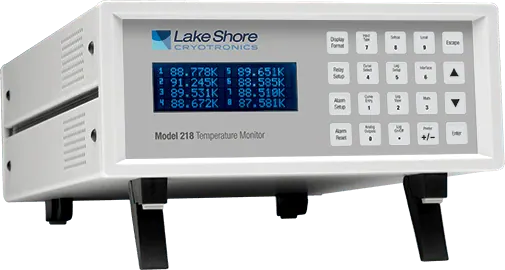
The Model 218 is a cryogenic temperature monitor with eight sensor inputs, arranged in two groups of four. It reads diode and RTD sensors down to 1.2 K and updates at up to 16 readings per second in total. It is used where several points in a cryogenic system must be monitored at once.
Technical Specifications
| Parameter | Value |
|---|---|
| Number of inputs | 8, separated into two groups of four with each group set to the same sensor type |
| Supported sensors | silicon and GaAlAs diodes, 100 Ω and 1000 Ω platinum, germanium, carbon-glass, Cernox and Rox RTDs |
| Maximum update rate | 16 rdg/s total |
| Excitation | 8 constant current sources, 4-lead differential measurement |
| User curves | room for 8 200-point CalCurves or user curves |
| Standard curves | DT-470, DT-500D, DT-670, CTI-C, PT-100 and PT-1000 |
Get a Quote
Request an itemised quotation covering the proposed configuration, availability, lead time and agreed supply and support scope.
Useful details to share
- Materials, sample dimensions and process or measurement goal
- Required performance and existing instrument interfaces
Share what you know. You can start with your name and a phone number or email; final specifications can follow.
Not sure which configuration you need? Help me choose
Contact Vvon Technologies Limited about Lake Shore equipment requirements in Bangladesh.
Phone: +8801805987890 | Email: info@vvon.com.bd
More from Cryogenics & Temperature Control
- Model 224 Cryogenic Temperature Monitor
The Model 224 is a cryogenic temperature monitor with 12 sensor channels that measures temperature down to 300 mK. It reads silicon diodes and both positive and negative temperature coefficient resistance sensors, using 4-lead differential measurement with current reversal on RTDs.
- Model 211 Cryogenic Temperature Monitor
The Model 211 is a single channel cryogenic temperature monitor that displays sensor temperature from 1.4 K to 800 K. It accepts silicon and GaAlAs diodes and platinum, carbon-glass and Cernox resistance sensors, with 24-bit measurement and a 5-digit LED display. It is used for temperature readout.
- 240 Series Input Modules
The 240 Series Input Modules read cryogenic temperature sensors and pass the measurement onto a distributed control network. They are intended for large scale installations that use PLC based control rather than a single benchtop instrument. They suit systems with many sensor points spread across a facility.