Model 700F Series Bipotentiostat
Brand: CH Instruments | Category: Nanotechnology
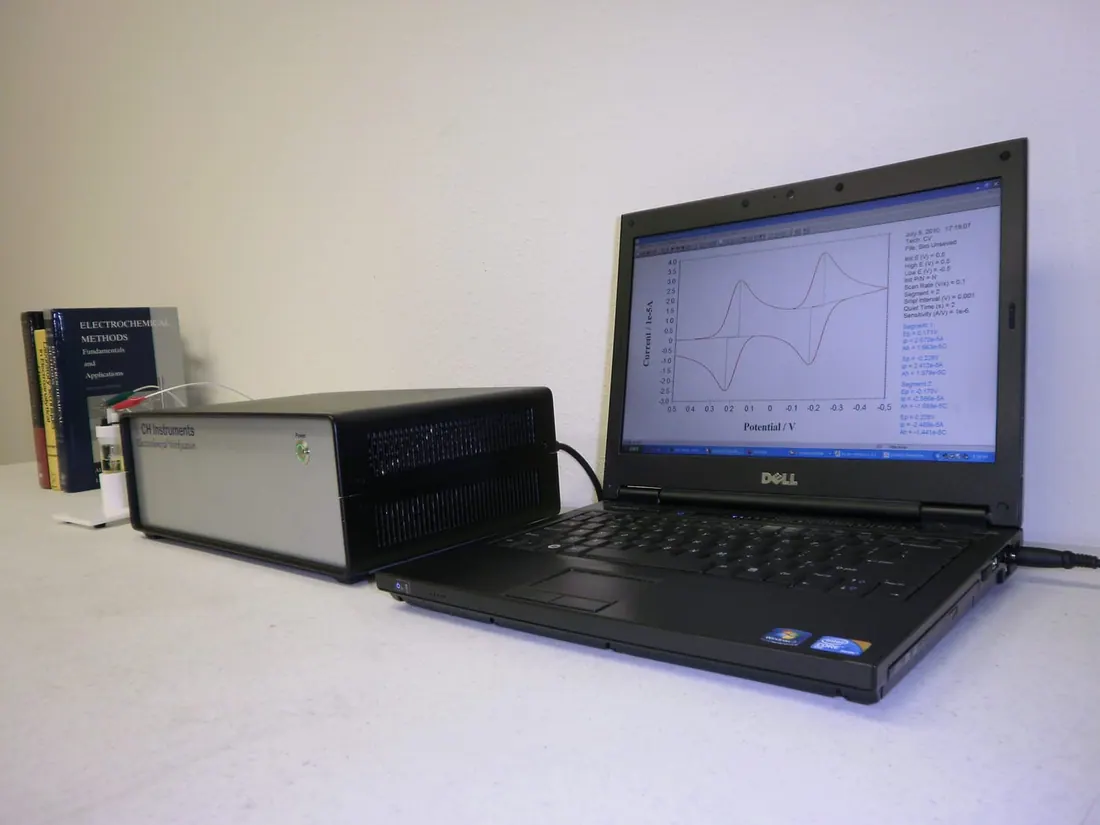
The 700F series is a general purpose bipotentiostat and galvanostat for experiments needing two controlled working electrodes, such as rotating ring disk electrode work and dual channel detection. Used as a single channel instrument it matches the 600F series. Models range from the 700F to the 760F.
Technical Specifications
| Parameter | Value |
|---|---|
| Maximum potential | +/-10 V for both channels |
| Maximum current | +/-250 mA continuous as the sum of two current channels, +/-300 mA peak |
| Potentiostat rise time | less than 1 us, 0.8 us typical |
| Measured current range | +/-10 pA to +/-0.25 A in 12 ranges |
| CV and LSV scan rate | 0.000001 to 10,000 V/s, two channels simultaneously |
| Fast data acquisition | dual channel 16 bit ADC, 2,500,000 samples per second |
Get a Quote
Request an itemised quotation covering the proposed configuration, availability, lead time and agreed supply and support scope.
Useful details to share
- Materials, sample dimensions and process or measurement goal
- Required performance and existing instrument interfaces
Share what you know. You can start with your name and a phone number or email; final specifications can follow.
Not sure which configuration you need? Help me choose
Contact Vvon Technologies Limited about CH Instruments equipment requirements in Bangladesh.
Phone: +8801805987890 | Email: info@vvon.com.bd
More from Electrical & Electrochemical Characterisation
- Model 800D Series Electrochemical Detector
The 800D series is built for electrochemical detection, monitoring current through a flow cell in liquid chromatography or flow injection analysis. Its low noise circuitry measures down to picoamperes and plots three decades of current scale during a run. The 8x2D models add a bipotentiostat for dual channel work.
- Model 600F Series Potentiostat/Galvanostat
The 600F series is a general purpose electrochemical workstation containing a fast function generator, dual channel data acquisition, a potentiostat and, on selected models, a galvanostat. It covers voltammetry, pulse techniques, corrosion and impedance work. Models run from the basic 600F to the 660F workstation.
- Model 920D Series Scanning Electrochemical Microscope (SECM)
The 920D scanning electrochemical microscope combines a bipotentiostat with a three dimensional nanopositioner, cell and sample holder to map chemical reactivity near surfaces. Modes include SECM imaging, probe scan and approach curves, surface interrogation SECM and surface patterned conditioning.