OmniProbe 400
Brand: Oxford Instruments | Category: Nanotechnology
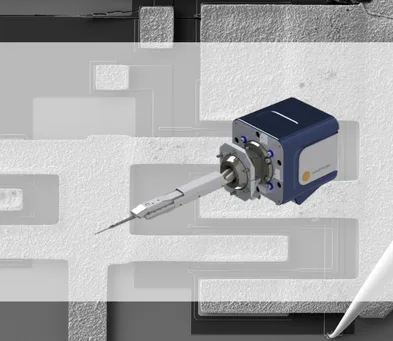
Now in its ninth generation, this nanomanipulator applies piezo actuation to nanoscale positioning in the FIB and SEM, offering four degrees of freedom in X, Y, Z and R with 4 mm or more of working distance. Nanometre-resolution piezo actuators paired with 10 nm closed-loop encoders deliver precision, linearity and smooth motion, and closed loop control lets the operator navigate to stored positions and move orthogonally at any sample tilt. Motorised concentric rotation and in situ tip changes come as standard, so probe needles can be swapped in under 3 minutes without venting the microscope. Insertion and retraction are non-pneumatic, which is gentle on fragile samples.
Selected manufacturer specifications
| Parameter | Value |
|---|---|
| Linearity | 250 nm |
| Encoder resolution | 10 nm |
| Insertion repeatability | 2 μm |
| Min velocity | 10 nm/s |
| Max Velocity | 500 μm/s |
Values from the OmniProbe 400 column of the manufacturer comparison. OmniProbe 350 and 350 Cryo have different specifications and are not substituted. Confirm installation compatibility and the selected accessories. Checked 2026-09-29.
Confirm your configuration
Share the details you know so we can prepare a comparable, itemised offer.
- Specimen or clinical application and required imaging/measurement outputs
- Optics/source, detectors, working distance, stage and documentation options
- Room conditions, utilities, preparation accessories and operator training
Get a Quote
Request an itemised quotation covering the proposed configuration, availability, lead time and agreed supply and support scope.
Useful details to share
- Materials, sample dimensions and process or measurement goal
- Required performance and existing instrument interfaces
Share what you know. You can start with your name and a phone number or email; final specifications can follow.
Not sure which configuration you need? Help me choose
Contact Vvon Technologies Limited about Oxford Instruments equipment requirements in Bangladesh.
Phone: +8801805987890 | Email: info@vvon.com.bd
More from Electron Microscopy & Microanalysis
- Ultim Max TLE
Ultim Max TLE is the Oxford Instruments flagship silicon drift detector for the TEM, optimised for elemental characterisation at the atomic scale with maximum count rates at the smallest probe sizes. Its performance comes from an optimised sensor shape, a 100 mm2 sensor, windowless construction, an optimised mechanical design and Extreme electronics. The detector is also aimed at biological sample analysis, where it collects data quickly and accurately on beam sensitive samples by maximising the count rate of low energy X-rays. Extreme electronics combined with the X4 pulse processor allow in situ EDS mapping and quantification at elevated temperatures.
- inLux SEM Raman interface
An interface that brings Raman, photoluminescence and cathodoluminescence analysis into a scanning electron microscope chamber. The sample stays still between SEM imaging and Raman collection, so the two data sets are co-located, and the probe retracts with a single click.
- Ultim Max TEM
Ultim Max TEM is the Oxford Instruments silicon drift detector for nanoscale analysis and elemental mapping in the TEM. A low profile 80 mm2 sensor sits closer to the specimen and so collects more X-ray counts under any condition, and combined with windowless construction and Extreme electronics it delivers high performance EDS for 200kV instruments. An increased solid angle and take off angle reduce shadowing by bulky in situ holders, which supports mapping of samples in gas or liquid cells.