Taiko PDL M1
Brand: PicoQuant | Category: Nanotechnology
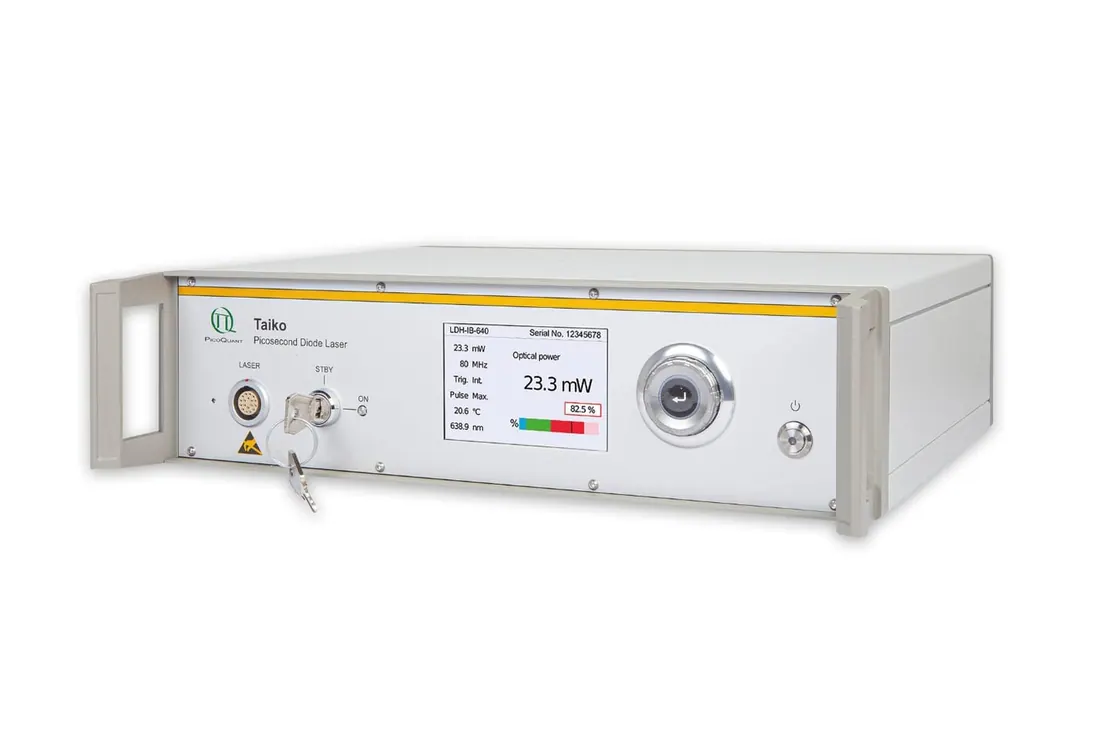
The Taiko PDL M1 is a picosecond diode laser driver with pulse shaping and automatic calibration of the connected laser head. It operates in pulsed, burst or continuous wave mode from 1 Hz to 100 MHz, with typical jitter of 3 to 5 ps. It is used for time-resolved experiments that need stable, adjustable excitation.
Technical Specifications
| Parameter | Value |
|---|---|
| Internal oscillator | crystal locked |
| Operation mode | pulsed, burst or Continuous wave (CW) |
| Repetition frequency range | 1 Hz to 1 MHz in steps of 1, 2 or 5 times various powers of ten, and 1 to 100 MHz in steps of 1 MHz |
| Jitter | typ. 3-5 ps |
| External trigger frequency range | single shot to 90 MHz |
| Delay, trigger input to optical output | typ. 16 ns |
Get a Quote
Request an itemised quotation covering the proposed configuration, availability, lead time and agreed supply and support scope.
Useful details to share
- Materials, sample dimensions and process or measurement goal
- Required performance and existing instrument interfaces
Share what you know. You can start with your name and a phone number or email; final specifications can follow.
Not sure which configuration you need? Help me choose
Contact Vvon Technologies Limited about PicoQuant equipment requirements in Bangladesh.
Phone: +8801805987890 | Email: info@vvon.com.bd
More from Photoluminescence & Time-Resolved Spectroscopy
- Prima
Prima is a compact stand-alone gain-switched picosecond laser that provides three wavelengths in one unit. The wavelength options are 375, 405, 450, 485, 515 and 640 nm, and the repetition rate is selectable from 1 kHz to 200 MHz. It supports pulsed and CW excitation for nanosecond to millisecond experiments.
- PDL 800-D
The PDL 800-D is a driver unit for picosecond pulsed diode laser heads. It runs in pulsed or continuous wave mode from base frequencies of 80 MHz or 1 MHz, giving selectable repetition rates between 31.25 kHz and 80 MHz. External triggering is accepted over 10 Hz to 80 MHz for synchronisation with other equipment.
- VisIR
VisIR is a stand-alone picosecond laser for the infrared, with wavelengths available from 765 to 1950 nm and a spectral width well below 1 nm. Internal repetition rates are selectable between 31.25 kHz and 80 MHz, and external triggering runs from below 1 Hz to 80 MHz. It is used for STED, LiDAR and materials research.