TIM L58
Brand: Linseis | Category: Nanotechnology
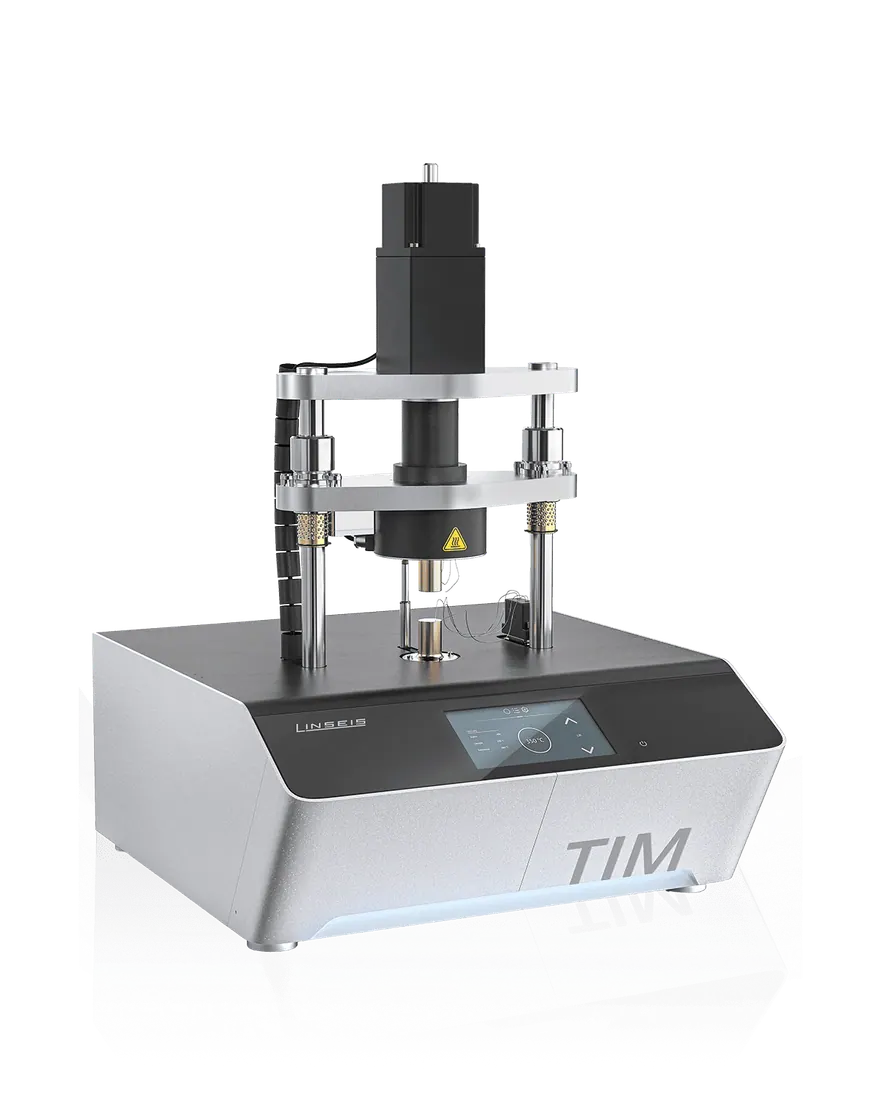
The TIM L58 measures the thermal resistance of thermal interface materials under realistic contact pressure. Sample thickness and applied force are varied to reproduce assembly conditions, with evaluation routines to ASTM D5470. It is used in electronics, battery and thermal management work.
Technical Specifications
| Parameter | Value |
|---|---|
| Sample thickness | 0.001 to 8 mm (optionally up to 20 mm) |
| Resistance range of the sample | 0.005 to 500 cm2K/W |
| Force options | 1 kN, 2 kN and 5 kN |
| Specification | Standardised evaluation routines according to ASTM D5470 |
Get a Quote
Request an itemised quotation covering the proposed configuration, availability, lead time and agreed supply and support scope.
Useful details to share
- Materials, sample dimensions and process or measurement goal
- Required performance and existing instrument interfaces
Share what you know. You can start with your name and a phone number or email; final specifications can follow.
Not sure which configuration you need? Help me choose
Contact Vvon Technologies Limited about Linseis equipment requirements in Bangladesh.
Phone: +8801805987890 | Email: info@vvon.com.bd
More from Thermal Analysis & Thermophysical Measurement
- LZT L32
The LZT L32, also published as the LZT-Meter, combines an LSR and an LFA in one instrument, so thermal conductivity, electrical resistance and the Seebeck coefficient are measured on the same sample. These values give the thermoelectric figure of merit ZT. Interchangeable furnaces cover -100 C to 1100 C.
- HFM L57
The HFM L57 is a heat flow meter that determines the thermal conductivity of insulating and low conductivity materials. The sample is held between two temperature-controlled plates and the heat flow through it is measured. Design follows ASTM C518, JIS A1412, ISO 8301, DIN EN 12664 and DIN 12667.
- LSR L33
The LSR L33, formerly the LSR-3, measures the Seebeck coefficient and the electrical conductivity of solids and thin films. The sample is clamped vertically between two electrodes and interchangeable furnaces cover -100 C to 1500 C. It is used to characterise thermoelectric materials.