Ultim Max Infinity
Brand: Oxford Instruments | Category: Nanotechnology
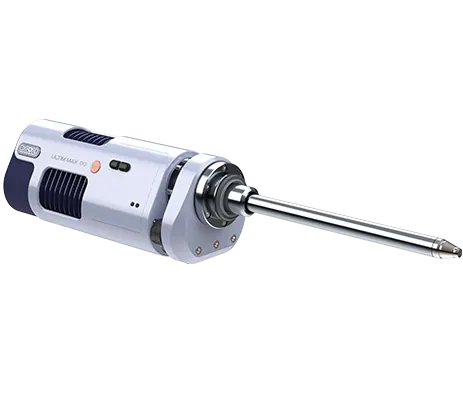
Ultim Max Infinity is the Oxford Instruments silicon drift detector range for energy dispersive X-ray analysis in the SEM. Sensor sizes from 40 to 170 square millimetres all give the same analytical performance, with a motorised slide for insertion and retraction.
Plan your specification
Compare the Ultim Max Infinity configuration
Ultim Max Infinity offers different sensor sizes. Compare the proposed detector and analysis package using your intended beam conditions, specimens and workload.
- Microscope compatibility
- Provide the exact SEM model, ports, stage, other detectors and computer details. Request written confirmation of mechanical fit, interfaces and installation responsibilities.
- Sensor size, installed geometry and useful throughput
- Request the offered sensor size and energy-resolution specifications with their test conditions, then compare spectra and mapping time on representative samples.
- Software and acceptance scope
- List licences, data exports, workstation, training and the sample demonstration in the offer. Agree what will be checked after installation and the support terms.
Product documentation
Technical Specifications
| Parameter | Value |
|---|---|
| Sensor sizes | 40 mm2 up to 170 mm2, all with the same analytical performance |
| Resolution guaranteed at C Ka | 46 eV or better at all count rates up to 50,000 cps |
| Resolution guaranteed at Mn Ka | 127 eV or better at all count rates up to 200,000 cps |
| Specification | Tru-Q IQ spectrum processing, each detector characterised on SEM during manufacture |
| Specification | Integrated motorised slide for rapid insertion and retraction |
Get a Quote
Request an itemised quotation covering the proposed configuration, availability, lead time and agreed supply and support scope.
Useful details to share
- SEM model, port and existing detector configuration
- Sample types, target elements and required outputs
Share what you know. You can start with your name and a phone number or email; final specifications can follow.
Not sure which configuration you need? Help me choose
Contact Vvon Technologies Limited about Oxford Instruments equipment requirements in Bangladesh.
Phone: +8801805987890 | Email: info@vvon.com.bd
More from Electron Microscopy & Microanalysis
- Ultim Extreme Infinity
Ultim Extreme Infinity is a windowless energy dispersive X-ray detector for ultra high resolution field emission SEM. Its shaped sensor sits close to the sample at very short working distance, so elemental analysis can be run at the low kV used for nanomaterials and surfaces.
- MirrorCLEM System for Correlative Light and Electron Microscopy
MirrorCLEM correlates specimens between optical and electron microscopes. A specimen imaged on any light microscope is transferred to the Hitachi SEM stage, where the optical image acts as an anchor map that drives the stage to a chosen region and overlays both images in real time.
- Xplore
Xplore is a compact energy dispersive X-ray detector for routine microanalysis in the SEM. It uses the same X4 electronics as the larger Ultim Max Infinity detectors in a smaller package, with motorised insertion and extra cooling removed to reduce parts and allow in field repair.