Unico
Brand: PicoQuant | Category: Nanotechnology
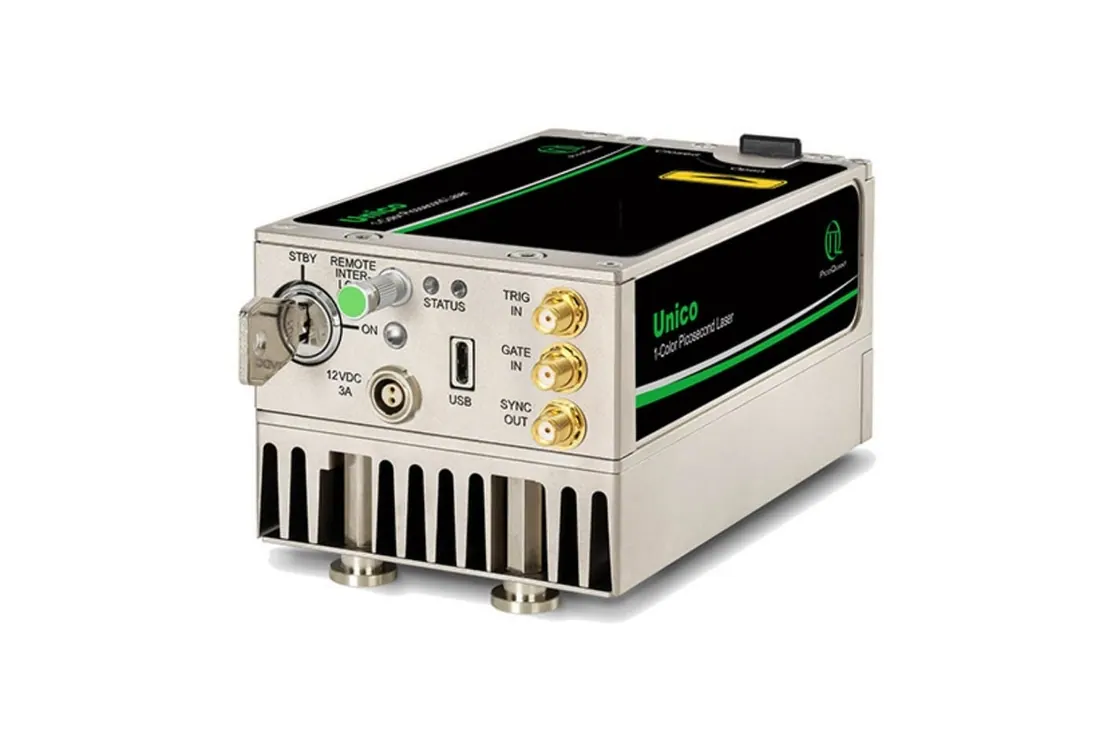
Unico is a compact stand-alone gain-switched picosecond laser supplying a single wavelength per unit. The options are 375, 405, 450, 485, 515 and 640 nm, with the repetition rate selectable from 1 kHz to 200 MHz and jitter below 12 ps RMS. It is used for time-resolved methods such as TRPL and FLIM.
Technical Specifications
| Parameter | Value |
|---|---|
| Available wavelength | 375, 405, 450, 485, 515, 640 nm |
| Repetition rates (internal) | user selectable 1 kHz to 200 MHz, in 1 kHz increments from 1 to 999 kHz and 1 MHz increments from 1 to 200 MHz |
| Repetition rates (external) | single shot to 200 MHz |
| Jitter | < 12 ps (RMS) |
| Polarization Extinction Ratio (PER) | Typ. > 30:1 (> 15 dB) |
| Power stability (12 hours) | < 3 % RMS |
Get a Quote
Request an itemised quotation covering the proposed configuration, availability, lead time and agreed supply and support scope.
Useful details to share
- Materials, sample dimensions and process or measurement goal
- Required performance and existing instrument interfaces
Share what you know. You can start with your name and a phone number or email; final specifications can follow.
Not sure which configuration you need? Help me choose
Contact Vvon Technologies Limited about PicoQuant equipment requirements in Bangladesh.
Phone: +8801805987890 | Email: info@vvon.com.bd
More from Photoluminescence & Time-Resolved Spectroscopy
- CPDL-Q
The CPDL-Q are compact picosecond diode laser modules intended for integration into other instruments. The internal repetition rate is selectable from 1 kHz to 200 MHz, timing jitter stays below 12 ps RMS and optical gating rises or falls in under 3 ns. Each module measures 40 x 40 x 160 mm and weighs 0.31 kg.
- VisUV
VisUV is a stand-alone picosecond laser covering wavelengths from 266 to 590 nm with a spectral width well below 1 nm. Internal repetition rates are selectable between 31.25 kHz and 80 MHz, and external triggering runs from below 1 Hz to 80 MHz. It provides UV to visible excitation for time-resolved research.
- CPDL-S-F/FA Series
The CPDL-S-F/FA Series are compact picosecond diode laser modules with fibre output for integration into other equipment. The FC/APC receptacle takes single mode polarisation maintaining fibre with a built in optical isolator, and triggering runs from single shot to 100 MHz. They suit time-resolved and sensing work.